
Selling a Home With a Second Unit in Mississauga
If you're selling a home with a second unit in Mississauga, buyers, their agents and your own lawyer will all ask the same question: is it registered? I'm Navneet Bhasin, a real estate agent with eXp Realty, Brokerage, and I've listed Mississauga homes with basement apartments that were registered, ones that never were, and a few where the seller genuinely didn't know which they had. The difference changes how you price the home, what you disclose, and how smoothly the deal closes.
Key Takeaways
- All second units in Mississauga must be registered with the City under the Second Units Registration By-law; registration itself is free, but the unit must meet the Ontario Building Code, Ontario Fire Code and the Zoning By-law first.
- As of the City's September 2026 registry update, 4,909 second units were registered in Mississauga, up from 4,546 in January 2026 — a reminder that registration has been climbing steadily all year.
- Ontario law does not require a seller to volunteer every patent defect, but it does require disclosure of latent defects and known material facts, which can include an unpermitted second unit depending on the circumstances.
- A Seller Property Information Statement is optional, not mandatory, and your agent must tell any interested buyer if one exists.
- An unregistered second unit doesn't necessarily disqualify your home from selling, but it does change how buyers, lenders and appraisers treat the income potential and the renovation history.
Quick Answer: Selling a Home With a Second Unit in Mississauga
Selling a home with a second unit in Mississauga starts with finding out, in writing, whether that unit is registered with the City. If it is, you'll want the registration confirmation, the building permit sign-off and any fire inspection paperwork ready for your lawyer and for buyers. If it isn't, you are not legally barred from selling, but you and your agent need to be deliberate about what you know, what you disclose, and how the home is priced and marketed. Buyers increasingly ask this question upfront, and an honest answer builds more trust than a vague one.
Is Your Second Unit Registered With the City of Mississauga?
Mississauga defines a second unit as a self-contained living space with its own cooking, sleeping and sanitary facilities, located within a detached house, semi-detached house or townhouse. The City requires every second unit to be registered under its Second Units Registration By-law, and the registry list is updated during the second week of every month. The most recent file I checked, dated early September 2026, showed 4,909 total registered units — up from 4,546 in January, so registrations have been climbing steadily all year.
Registration is free. It requires a completed Second Unit Registration Form, proof of ownership such as a tax bill, and a copy of the second unit's building permit signed off by every City inspector, sent to secondunits@mississauga.ca. If a seller never pulled a permit for the basement renovation, there's no permit copy to produce — the single most common reason a Mississauga second unit sits unregistered for years.
Before you list, check the registry yourself or ask me to check it with you. If the address isn't on the list, that tells you the unit is not registered, not necessarily that it's unsafe or illegal to rent — but it does mean the paperwork trail isn't there, and buyers will notice its absence.
What Ontario Law Requires You to Disclose About a Second Unit
Ontario's disclosure rules for home sellers come from case law, not a single statute, and the Real Estate Council of Ontario draws a useful line between two kinds of problems. A patent defect is one a buyer or inspector could reasonably find on their own — you generally don't have to point it out, though hiding one can cost you that protection. A latent defect is different: something that makes a property unfit for habitation, dangerous, or potentially dangerous, and not obvious to a careful inspection. Sellers must disclose latent defects, and failing to do so can be treated as misrepresentation.
Where does an unregistered second unit fit? It isn't automatically a latent defect, but RECO's guidance on material facts lists two things that are squarely relevant: "renovations and improvements made to a property and whether the required permits were obtained," and zoning by-laws "impacting the legal use of the property." A second unit built without a permit, or one that doesn't comply with Mississauga's zoning by-law for the property type, touches both categories. What counts as material can depend on the buyer, which is exactly why RECO's own advice to agents is "when in doubt, disclose and explain it."
You may also be asked to complete a Seller Property Information Statement. It's optional, and if you provide a buyer-facing version, your agent must tell every interested buyer it exists and give a copy to anyone who asks. I walk every seller through the pros and cons before they sign anything, since an inaccurate SPIS can create more risk than simply disclosing what you know.
None of this is legal advice. I'm a real estate agent, not a lawyer, so any real doubt about what you're required to disclose deserves a conversation with a real estate lawyer before your home goes on the market, not after an offer arrives.
Selling a Home With a Second Unit in Mississauga That Isn't Registered
An unregistered second unit in Mississauga is far more common than most sellers expect, and it does not automatically kill a sale. What it does is shift the conversation. Buyers and their lawyers will ask direct questions: was a permit pulled, is the unit on the City's registry, and is the rental income you're advertising something a lender will actually count. Appraisers and lenders are typically conservative about rental income from a unit that can't be verified against a registration or permit.
The honest path works better than the vague one. I tell sellers to say plainly what they know — whether a permit exists, whether the City has been contacted, and what condition the space is in. Buyers planning to rent the unit will usually want time to verify registration status before closing, and setting that expectation early avoids a renegotiation two weeks before your closing date. If you want to register before selling, that process starts with a building permit application, and it can take real time — a decision for months before listing, not during an active sale.
Pricing is the other half of this. A registered second unit with a documented rental history is a verifiable income feature. An unregistered one is a feature a buyer has to take partly on faith, and I price and market it that way rather than overselling a rental number nobody can confirm yet.
What to Document Before You List
| Document | Why It Matters |
|---|---|
| Building permit (with inspector sign-off) | Required to register the unit; proves the work met code when it was done |
| Second Unit Registration confirmation | Shows the unit is on the City's registry, free to request, strongest proof for a buyer |
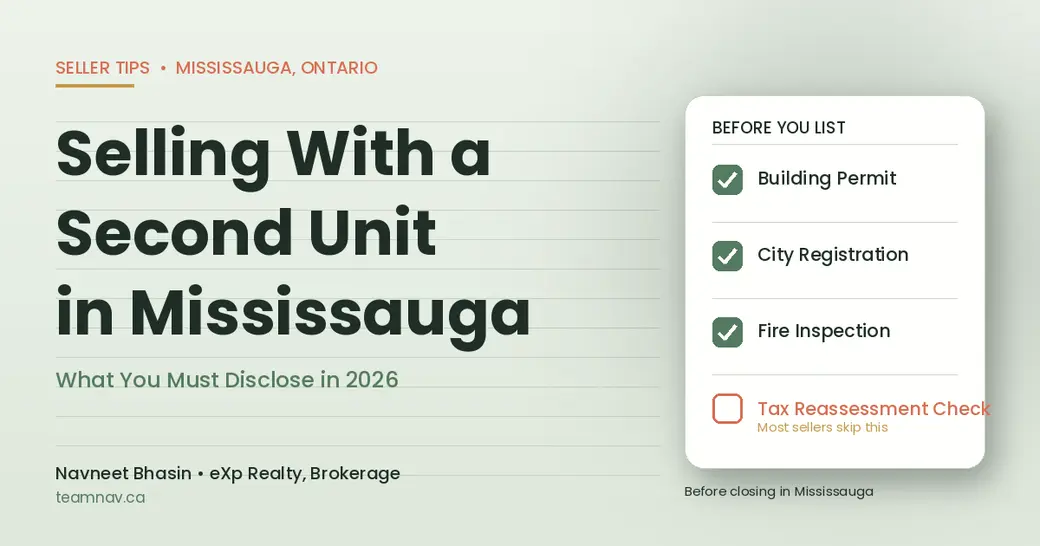
| Fire inspection records | Second units require fire code compliance; buyers and lenders ask for this |
| Rental history (if applicable) | Supports an income claim if the unit is tenanted, but only alongside registration proof |
| Latest MPAC property assessment notice | Shows whether the second unit has already triggered a reassessment |
| Any Seller Property Information Statement discussion with your lawyer | Documents what you disclosed and when, protecting you if a dispute arises later |
If any of this paperwork is missing, say so rather than guessing. "I don't have a permit for that renovation" has never ended a deal for one of my sellers — vague answers that turn out to be wrong are what create problems after closing.
How a Second Unit Affects Price, Taxes and Your Buyer Pool in Mississauga
In TRREB's September 2026 Market Watch, Mississauga condo apartments averaged $500,192 across 122 sales, while condo townhouses averaged $717,408. Across all home types, Mississauga saw 468 sales at an average price of $929,600 against 1,371 new listings — about 2.93 new listings for every sale. A home with a verified, income-producing second unit widens your buyer pool to investors as well as end users, and in a market with nearly three new listings per sale, that's a feature worth documenting properly.
Property taxes are the other piece sellers forget. Mississauga's total residential tax rate works out to roughly $1,087.90 per $100,000 of assessed value. Current Ontario assessments are still based on a January 1, 2016 valuation date — the province has postponed the next province-wide update again, so your 2026 assessed value equals your 2025 one unless the property itself physically changed. A second unit can be exactly that kind of change: in neighbouring Brampton, the City's own additional-residential-unit guidance warns that permit information may be forwarded to MPAC, which can trigger a reassessment. Ask for the seller's actual tax bill rather than applying a rate to the sale price — I do this on every Mississauga offer I write, because the two numbers aren't interchangeable.
On the rental side, CMHC's mid-year 2026 update put Toronto-area apartment vacancy at 3.0% for 2025, with a preliminary 2026 range of 2.5% to 4.0%. That's an honest counterweight for anyone tempted to market a second unit on an optimistic rental figure: underwrite with a realistic rent and a real vacancy allowance, not a best case.
Frequently Asked Questions
Do I have to disclose an unregistered second unit when I sell my Mississauga home?
You're not required to volunteer every patent defect, but known material facts — including whether required permits were obtained — are different. Talk to a real estate lawyer before listing if you're unsure where your situation falls.
How do I check if my second unit is registered with the City of Mississauga?
Check the City's Second Units Registry list, updated during the second week of each month, or ask me to check the address with you. If it isn't listed, the unit isn't registered, which doesn't necessarily mean it's unsafe, but it does mean the paperwork isn't on file.
Does an unregistered second unit lower my home's value in Mississauga?
Not automatically, but it changes how buyers and lenders treat any rental income from the unit. A registered unit with documented history is easier to underwrite than one a buyer has to take on faith, so I price and market the two differently.
Is a Seller Property Information Statement mandatory in Ontario?
No. Your agent may ask you to complete one, but it's optional. If you provide a buyer-facing version, your agent must tell every interested buyer it exists and give a copy to anyone who requests it.
Will registering my second unit before I sell affect my property taxes?
It can. MPAC assessments are frozen at a 2016 valuation date unless the property changed, and a second unit can be that kind of change — permit information can be forwarded to MPAC and trigger a reassessment. Ask for the actual tax bill rather than estimating from the sale price.
Ready to Sell Your Mississauga Home With Confidence?
Whether your second unit is fully registered, a work in progress, or something you inherited without a paper trail, the plan is the same: find out exactly what you have, document it honestly, and price it accordingly. I've guided Mississauga sellers through all three situations, and the ones who come to me before listing — not after an offer is on the table — end up with the smoothest closings.
If you want an honest read on what your Mississauga home with a basement apartment is worth right now, schedule a free consultation with me at teamnav.ca. I'm Navneet Bhasin with eXp Realty, Brokerage — reach me directly at (905) 872-2682 or nav@teamnav.ca.
This article is for general information only and is not legal, tax or financial advice. I'm a real estate agent, not a lawyer, a building inspector or a mortgage professional — consult the appropriate licensed professional about your specific property before making a decision.
Categories
Recent Posts