
Basement Apartment Rules in the GTA: 2026 City Comparison
The basement apartment rules in the GTA start with one provincial rule and then split four ways. Ontario's Planning Act already permits up to three residential units on most urban residential lots, without a rezoning. What your city does on top of that — how many units it allows, what it calls them, how many parking spaces it demands, what registration costs and whether that registration expires — is set locally, and it is not the same in Brampton as it is in Mississauga, Milton or Oshawa.
I sell homes across all four of those markets, and this is the question I get asked more than almost any other. So I went to each municipality's own published material and put the four regimes side by side.
Key Takeaways
- Ontario's Planning Act permits up to three units on most urban residential lots as-of-right, and that permission "supersedes local zoning," according to the province's Citizens' Guide to Land Use Planning (last updated 23 February 2026).
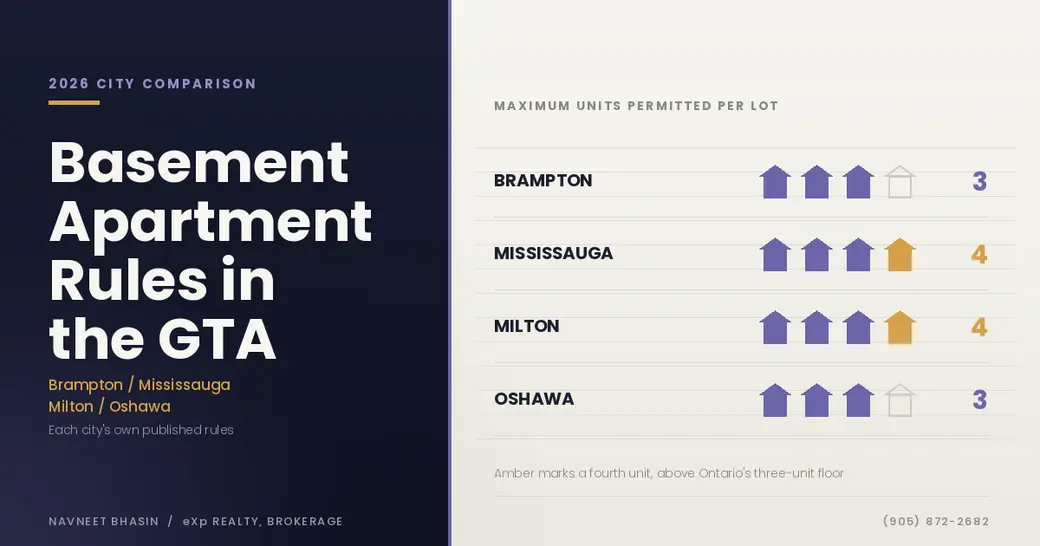
- Mississauga and Milton both go past that floor and allow four units on a serviced residential lot. Brampton and Oshawa cap it at three.
- Registration cost ranges from nothing in Mississauga to $340 per unit in Milton — and Milton's certificate is the only one of the four that has to be renewed every year.
- Oshawa requires a bigger parking space than Brampton does (2.75 m x 5.75 m against 2.6 m x 5.4 m) and does not allow tandem parking, so the same driveway can pass in one city and fail in the other.
- Mississauga is the only one of the four that publishes a registry list of registered units, updated the second week of every month.
What are the basement apartment rules in the GTA in 2026?
Quick answer: in 2026 the basement apartment rules in the GTA are set in two layers. The provincial layer, under the Planning Act, permits up to three residential units on most urban residential properties as-of-right — either three units inside the main house, or two inside the house plus one in an ancillary building such as a garden suite. The municipal layer sets everything else: the maximum unit count your city actually allows, the zones it applies in, parking, setbacks, registration and fees. A unit that satisfies the province can still fail the city's zoning by-law, and a unit built without a permit is not legal no matter how long it has been there.
Why do the basement apartment rules in the GTA use four different names?
Because no two of these municipalities use the same word for it, and that is the single biggest reason homeowners get wrong answers.
Brampton calls it an additional residential unit, or ARU. Mississauga calls it a second unit. Milton also says ARU. Oshawa calls it an accessory apartment, regulated under section 5.12 of Zoning By-law 60-94.
Milton goes further than a naming preference. Its own ARU InfoGuide states flatly that "the term 'legal basement apartment' is not recognized by the Town." That is worth sitting with, because "legal basement apartment" is exactly the phrase most sellers put in a listing and most buyers type into a search bar. In Milton it has no official meaning at all.
The practical consequence: when you phone the City, use the municipality's own term. Asking Oshawa about an "ARU" or Milton about a "legal basement apartment" is how a five-minute answer turns into a week of being transferred.
How many units do the basement apartment rules in the GTA allow?
Three of the four permit three units. Mississauga and Milton permit four.
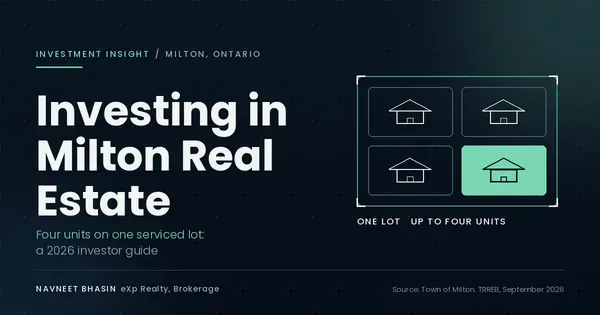
Mississauga's building and renovating pages say outright that you can "Build up to four units on your residential property" — either up to two additional units on a detached, semi-detached or town home, or a fourplex. Milton reaches the same total from the other direction: the Town permits up to three additional residential units on a lot with a detached, semi-detached or townhouse dwelling, so "up to four residential units in total are now permitted on a residential lot with municipal water and sewage services." Those amendments "came into effect on June 25, 2024."
Brampton holds at three, and is specific about the combinations: the principal dwelling plus one attached second unit plus one separate garden suite, or the principal dwelling plus an attached second and third unit. Oshawa also caps at three per lot, with a maximum of one of those in an accessory building.
| City | Maximum units per lot | What the city calls it | Registration | Published registration fee |
|---|---|---|---|---|
| Ontario (Planning Act floor) | 3 | Additional residential unit | Set by the municipality | Set by the municipality |
| Brampton | 3 | Additional residential unit (ARU) | One-time, mandatory, including units previously treated as legal non-conforming | $200, or $400 for a second and third unit together, plus a deposit |
| Mississauga | 4, or a fourplex | Second unit | Mandatory under the Second Units Registration By-law; registered units appear on a public list | "There is no fee to register a second unit" |
| Milton | 4 (up to three ARUs) | Additional residential unit (ARU) | Mandatory for new and existing units, renewed every year | $340 per ARU |
| Oshawa | 3, with at most 1 in an accessory building | Accessory apartment | Two-unit house registration certificate within 60 days of final inspection | Not published on the City's page |
Sources: each municipality's own published pages and guides, read 2 November 2026. Confirm any specific property with the city before you rely on it.
Where the basement apartment rules in the GTA differ most: parking
Parking is where two otherwise similar properties stop being comparable, and it is the detail I see derail the most second-unit plans.
| City | Spaces required | Minimum size per space | Tandem permitted |
|---|---|---|---|
| Brampton | One additional space where two ARUs are proposed; none required for a second unit alone or a garden suite alone | 2.6 m x 5.4 m in the City's homeowner guide | Yes |
| Oshawa | 3 spaces for two units; 4 spaces for three units | 2.75 m x 5.75 m | No, apart from one space permitted in a side yard, rear yard or garage |
| Mississauga | Not stated on the City's additional-units page | Not stated | Not stated |
| Milton | Not printed in the Town's ARU InfoGuide | Not printed | Not printed |
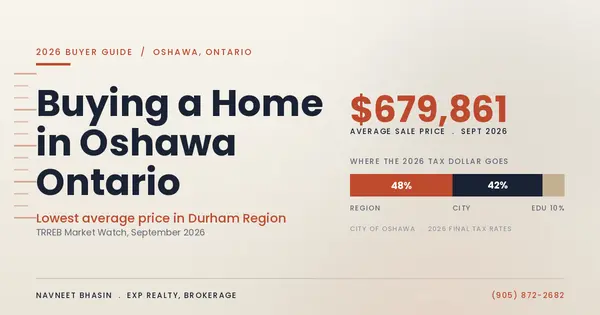
Run the arithmetic and the gap is real. An Oshawa space is 15.81 square metres; a Brampton space is 14.04. That is about 13 per cent more room demanded per car, on four spaces instead of one additional space, with tandem ruled out. In Oshawa, two of your three spaces must have unobstructed direct access to the street, and at three units, three of the four must.
So a standard two-car driveway that comfortably supports a second unit in Brampton can fail outright on an equivalent Oshawa lot. If you are buying with a second unit in mind, measure the driveway before you measure the basement.
Mississauga and Milton simply do not publish their parking ratios on the pages a homeowner lands on first. That is not the same as there being no requirement — both say the unit must comply with the zoning by-law. It means you have to ask.
What does registration cost, and does it expire?
The spread here is wider than most owners expect.
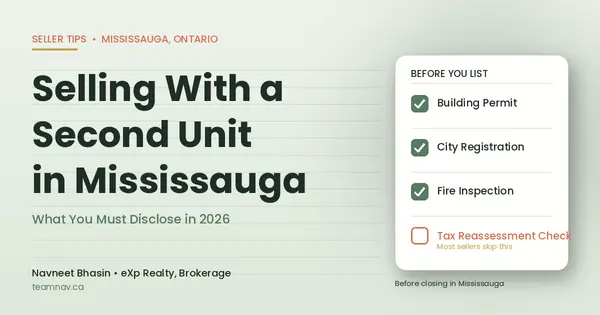
Mississauga is free. The City states plainly: "There is no fee to register a second unit." You email proof of ownership, a copy of the signed-off building permit and the registration form to the City's second units address. Building permit and fire inspection fees are separate.
Brampton charges $200, or $400 if you register a second and third unit together, and takes a deposit of $481.05 — $1,667.29 for the two units together. Brampton's minimum residential permit fee under its fee schedule revised February 2026 is $326.21, so the permit sits on top.
Milton charges $340 per ARU, and is the outlier on renewal. Its certificate "is valid for one year" and must be renewed online annually. Renewals are free during a three-year pilot. Milton also allows no grace for older units: "All ARUs must be registered with the Town and there are no 'grandfathering' exemptions." And inspections "will only be scheduled after payment is received."
Oshawa publishes no fee amount on its accessory apartment page, pointing instead to the fee schedule in its Building By-law. Its certificate arrives "within 60 days of the building inspector's final inspection." Units created after July 1994 without a permit need one to legalize; units predating July 1994 go to Municipal Licensing.
One more line worth knowing: Brampton's own page warns that the City may forward ARU permit information to MPAC, which may raise the property's assessment, and with it the tax bill.
What the basement apartment rules in the GTA do not tell you
Every one of these four leaves gaps, and naming them honestly is more useful than guessing.
None of the four publishes a minimum unit size or a minimum ceiling height on its homeowner-facing page. Those live in the Ontario Building Code, and the cities consistently refer you to a qualified designer rather than answer property-specific questions. Milton does not print parking, floor area or ceiling height in its InfoGuide at all. Oshawa does not print fee amounts. Mississauga does not state a processing time, a deadline, a renewal requirement or a penalty.
A few conditions that catch people out:
- Conservation authority land. Brampton says a permit "will not be allowed to proceed" without Credit Valley Conservation or TRCA approval where it applies. Oshawa excludes hazard lands and sites without safe access, administered with CLOCA.
- Garden suites are new homes. Brampton requires them to be enrolled with Tarion, built by someone licensed with the Home Construction Regulatory Authority.
- Oshawa's accessory-building caps are tight. A unit in an accessory building is capped at 60 square metres, 4.5 m in height (5 m in R1-G and R1-H), set back 0.6 m from interior side and rear lot lines, at least 3 m from the main dwelling, with a hard-surfaced unobstructed walkway at least 0.81 m wide to the street line.
- Penalties are not trivial. Brampton lists administrative penalties of $250 to $1,500, with failing to register an ARU at $1,000 to $1,500.
Here is the line I give every buyer: an existing basement unit in a listing is not the same thing as a registered one. Mississauga is the only one of these four where you can check against a published registry list, updated the second week of every month. In the other three, the answer comes from the City, and it is worth getting in writing before the conditions come off.
Do the numbers still work for a landlord in 2026?
The ownership side and the rental side are moving in different directions right now, and an honest answer has to say so.
CMHC's Mid-Year Rental Market Update, published 9 June 2026, put the total apartment vacancy rate for Toronto at 3.0 per cent in 2025, with a preliminary 2026 range of 2.5 to 4.0 per cent. Asking rents were still falling, with landlords offering more incentives, and CMHC pointed to "competition from investor-owned rental condominium apartments, which is higher than usual" as a drag on absorption. Its two-bedroom asking rent index stood at 93.7 in the fourth quarter of 2025, against 96.1 a year earlier.
What that means practically: underwrite a second unit on a realistic rent and a real vacancy allowance, not last year's number. Add the permit, the registration fee, the renewal if you are in Milton, and the possibility of a higher assessment. The unit can still be the best value-add available on a GTA lot — it usually is — but it earns its keep on arithmetic, not optimism.
I am a real estate agent, not a building inspector, a lawyer or a mortgage professional, so treat all of this as general information rather than advice about your specific property.
Frequently asked questions
Do I need a permit for a basement apartment in Brampton?
Yes. Brampton requires a building permit and a one-time registration for every additional residential unit, including units previously treated as legal non-conforming. Registration is $200, or $400 for a second and third unit registered together, plus a deposit. The final registration certificate is issued when occupancy is granted.
How many units can I build on a lot in Mississauga?
Mississauga's published guidance says you can build up to four units on a residential property: either up to two additional units on a detached, semi-detached or town home, or a fourplex. Second units must be registered with the City under its Second Units Registration By-law, and there is no fee to register.
Does a Milton ARU registration expire?
Yes. Milton's ARU certificate is valid for one year and must be renewed online annually, with reminders sent before expiry. Renewals are free during the Town's three-year pilot. Registration is mandatory for new and existing units alike — the Town states there are no grandfathering exemptions.
What are the parking rules for an accessory apartment in Oshawa?
Oshawa requires three parking spaces for two units and four for three units, each at least 2.75 m by 5.75 m. One space may be in a side yard, rear yard or garage; the rest need unobstructed direct street access and cannot be tandem. Curb cuts need City or Region of Durham approval.
How do I check whether a basement apartment is legal before I buy?
Ask the municipality directly, in writing, before your conditions expire. Mississauga publishes a registry list of registered second units, updated the second week of every month. Brampton, Milton and Oshawa confirm status on request. A unit described as finished or rented in a listing has not necessarily been permitted or registered.
The bottom line
One provincial rule, four local answers. Mississauga and Milton let you reach four units; Brampton and Oshawa stop at three. Mississauga registers for free and publishes a list; Milton charges $340 and makes you renew every year; Brampton charges $200 and takes a deposit; Oshawa publishes no fee at all. And Oshawa's parking standard is strict enough on its own to change which properties are worth looking at.
If you are shopping for a home with a second unit, or weighing whether to add one to the house you already own, the city line on the map matters as much as the floor plan. I am happy to walk a specific property with you and flag what will need checking before you commit.
Schedule a free consultation with me, Navneet Bhasin of eXp Realty, Brokerage. Call (905) 872-2682 or visit teamnav.ca, and let's work out what your lot will actually support.
This article is general information, current as of 2 November 2026, and is not legal, financial, mortgage, tax or building-code advice. Municipal requirements change. Confirm any specific property with the city or town that governs it.
Categories
Recent Posts