
Bank of Canada Rate Increase: What It Means in Mississauga
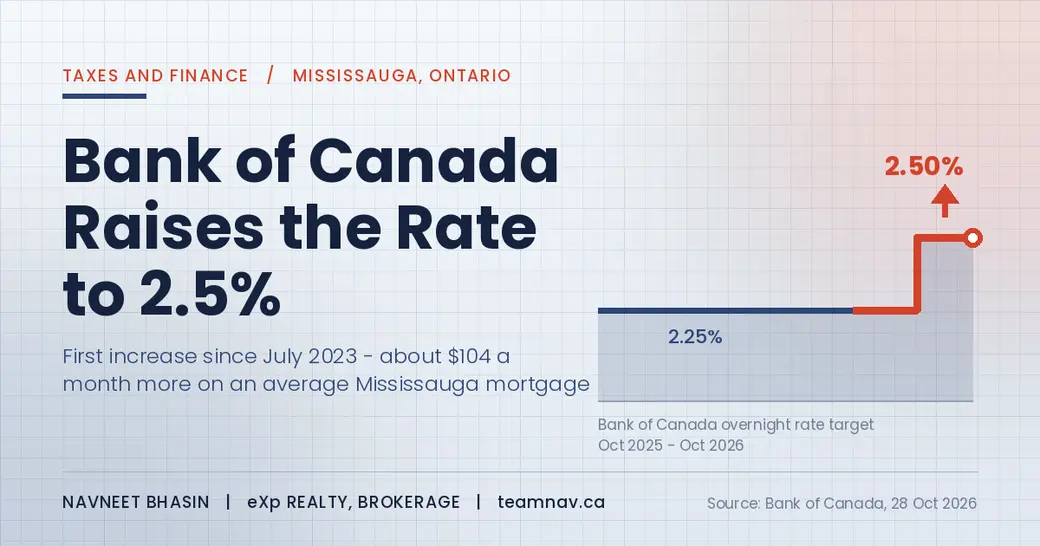
The Bank of Canada rate increase announced on 28 October 2026 lifted the policy interest rate by 25 basis points to 2.5 per cent, the first increase since July 2023. If you hold a variable-rate mortgage or a home equity line of credit in Mississauga, your borrowing cost went up within days. If you hold a fixed rate, nothing changes until renewal.
I am Navneet Bhasin, a real estate agent with eXp Realty, Brokerage, working with buyers and sellers across Mississauga and the wider GTA. My phone started ringing the morning of the announcement. Below is what I have been telling people, with every figure sourced and dated so you can check it yourself.
Quick answer: what does the Bank of Canada rate increase do to a mortgage?
A 0.25 percentage point increase in the policy rate feeds through to lenders' prime rates, which is what variable-rate mortgages and home equity lines of credit are priced against. On a 25-year amortization, a quarter-point move costs roughly $14 a month for every $100,000 you owe. On the $743,680 mortgage behind an average-priced Mississauga home with 20 per cent down, that is about $104 a month, or near $1,245 a year. Fixed-rate holders are unaffected until renewal. Nobody needs to make a decision this week.
Key takeaways
- The overnight rate target rose to 2.5 per cent on 28 October 2026, with the Bank Rate at 2.75 per cent (Bank of Canada, 28 October 2026).
- It was the first increase since July 2023 (CP24, 28 October 2026).
- The Bank blamed persistently high energy prices, not housing. CPI inflation has run near 3 per cent since April.
- Variable-rate and HELOC holders feel it within days. Fixed-rate borrowers feel nothing until renewal.
- Mississauga saw 468 sales at an average of $929,600 against 1,371 new listings in September 2026, or 2.93 new listings per sale (TRREB Market Watch, September 2026).
What the Bank of Canada rate increase actually changed on 28 October 2026
The Bank moved the overnight rate target from 2.25 per cent to 2.5 per cent, with the Bank Rate at 2.75 per cent and the deposit rate at 2.45 per cent. The rate had sat at 2.25 per cent since a cut on 29 October 2025, so this reversed exactly one year of standing still.
The reasoning is worth reading, because it is not about real estate. The Bank's statement points at energy: "With persistently elevated oil prices and refinery margins, inflation has risen in most countries." CPI inflation "has been around 3% since April and is expected to rise to about 3.5% by the end of the year," while inflation excluding gasoline was 2.2 per cent in September and core measures remain close to 2 per cent.
So the Bank is not trying to cool Mississauga's housing market. It is trying to stop an energy shock from leaking into everything else. Governing Council said it "decided to increase the policy rate to reduce the risk" that high energy prices "spread broadly to the prices of other goods and services."
Governor Tiff Macklem said the inflation outlook had "deteriorated" since July, and added: "There could be a need to raise the policy rate further, but given the uncertainties we will proceed carefully." The next scheduled announcement is 9 December 2026.
Which Mississauga mortgages feel the Bank of Canada rate increase first?
Not all of them, and the difference matters more than the quarter point itself.
Variable-rate mortgages and HELOCs. These are priced off a lender's prime rate, which generally tracks the policy rate. The Bank of Canada's published table showed a prime rate of 4.45 per cent as of 21 October 2026 and had not yet posted a figure for 28 October at the time of writing, so confirm the current number with your lender. If your payment is fixed and only the interest-principal split floats, the payment may not change, but more of it goes to interest and your amortization stretches.
Fixed-rate mortgages. Nothing changes mid-term. Your rate is your rate until maturity.
Renewals. This is the group I would plan around. Fixed rates follow bond yields rather than the policy rate, so they do not mechanically rise by a quarter point. The Bank of Canada's posted conventional mortgage rates on 28 October 2026 were 5.49 per cent for one year, 6.05 for three and 6.19 for five. Those are posted rates, higher than what borrowers typically negotiate, so read them as direction rather than a quote.
| Who you are | What changed on 28 October 2026 | When you feel it |
|---|---|---|
| Variable-rate mortgage holder | Interest cost rises with prime | Within days |
| HELOC holder | Interest cost rises with prime | Next statement |
| Fixed-rate mortgage holder, mid-term | Nothing | At renewal |
| Renewing in the next 12 months | Nothing yet | At renewal |
| Pre-approved buyer | Pre-approval rate usually held for a set window | When the hold expires |
What the Bank of Canada rate increase costs on a Mississauga-priced home
Mississauga's average sale price across all home types in September 2026 was $929,600 (TRREB Market Watch, September 2026). With 20 per cent down, that is a $743,680 mortgage.
On a 25-year amortization, a variable rate moving from 4.45 per cent to 4.70 per cent takes the monthly payment from about $4,095 to about $4,199: $104 a month, or roughly $1,245 a year. On the city's average condominium apartment price of $500,192, the same move costs about $56 a month.
The rule I give people over the phone: about $14 a month for every $100,000 of mortgage, for each quarter-point.
| Mississauga segment, September 2026 | Average price | Mortgage at 20% down | Added cost of +0.25 pt |
|---|---|---|---|
| All home types | $929,600 | $743,680 | about $104 a month |
| Detached | $1,285,467 | $1,028,374 | about $143 a month |
| Condominium apartment | $500,192 | $400,154 | about $56 a month |
Figures assume a 25-year amortization and semi-annual compounding, moving from 4.45 per cent to 4.70 per cent. Your own rate, term and amortization change the result, so treat these as scale rather than a quote.
For perspective, Ontario land transfer tax on a $929,600 purchase is $15,067 (Government of Ontario), and Mississauga buyers pay no municipal land transfer tax on top, unlike inside the City of Toronto. A quarter point costs roughly a twelfth of that land transfer tax bill in year one.
How the increase changes what you qualify for
This is the part that affects buyers more than the payment does.
Federally regulated lenders must qualify uninsured borrowers at a minimum qualifying rate: the greater of the mortgage contract rate plus two percentage points, or a 5.25 per cent floor (OSFI). So a contract rate of 4.70 per cent means qualifying at 6.70 per cent, not 4.70.
Because the buffer applies to whatever your contract rate is, a quarter-point increase raises your qualifying rate by the same quarter point. The effect on maximum purchase price is larger than the effect on your monthly payment, which is why a pre-approval issued in September may not stretch as far in December.
If you are mid-search in Mississauga, ask your mortgage broker or lender to re-run your approval at today's numbers before you write an offer. I am a real estate agent, not a mortgage professional, so this is general information rather than advice about your situation.
What Mississauga sellers should read into this
Very little, honestly, and that is the useful finding.
The Mississauga market was already a buyer's market before 28 October. September 2026 brought 468 sales against 1,371 new listings across all home types, which works out to 2.93 new listings for every sale. Across the GTA the sales-to-new-listings ratio was 37.8 per cent with 4.6 months of inventory and an average sale-price-to-list-price ratio of 98 per cent (TRREB Market Watch, September 2026).
Break Mississauga down by segment and the pressure is uneven. Semi-detached homes saw 1.97 new listings per sale, freehold townhouses 3.85, condominium townhouses 3.30 and condominium apartments 3.13. Carrying costs matter most where the buyer pool is thinnest, so if you are listing a condominium apartment this autumn, pricing precision matters more than it did a year ago.
For the wider picture, the Canadian Real Estate Association's 16 October 2026 forecast expects the Ontario average home price to fall 3 per cent in 2026, against a national average price forecast of $681,681, up 0.2 per cent (CREA). That forecast predates this rate decision.
Frequently asked questions about the Bank of Canada rate increase
Will my mortgage payment go up in Mississauga?
Only if your mortgage is variable or you hold a HELOC. Fixed-rate mortgages are unchanged until renewal. If you are variable with a fixed payment, the payment itself may hold steady while more of it goes to interest, which quietly lengthens your amortization.
How much does a quarter-point actually cost?
On a 25-year amortization, roughly $14 a month for every $100,000 of mortgage balance. On the $743,680 mortgage behind an average-priced Mississauga home with 20 per cent down, that is about $104 a month. The exact figure depends on your rate, term and amortization.
Should I lock into a fixed rate now?
That depends on your renewal date, your tolerance for payment movement and your plans for the property, and it is a conversation for a licensed mortgage professional. What I would say is that the Bank signalled it will "proceed carefully," so there is no need to act inside a single week.
Does this change Mississauga home prices?
Not directly, and not quickly. Mississauga already had 2.93 new listings for every sale in September 2026, so supply was doing more to set prices than borrowing costs were. Rate changes work through the market over quarters, not days.
When is the next Bank of Canada announcement?
9 December 2026, with the next Monetary Policy Report scheduled for 27 January 2027. The Bank publishes its decisions at the same time of day on each announcement date, so the figure in this post is current as of 29 October 2026.
The bottom line on the Bank of Canada rate increase for Mississauga
Three things are true at once. The policy rate went up for the first time since July 2023, a genuine turn in the cycle. The cost to a Mississauga household on a variable-rate mortgage is real but modest, around $104 a month on an average-priced home. And what is shaping Mississauga prices right now is still supply, with nearly three new listings arriving for every sale.
What really changes is qualifying power. If you are buying, get your approval re-run. If you are selling, price to the segment you are in, because a condominium apartment and a semi-detached home are not facing the same buyer pool this autumn.
If you want to walk through what this means for a specific property or budget in Mississauga, schedule a free consultation or call me at (905) 872-2682.
Navneet Bhasin is a GTA real estate agent with eXp Realty, Brokerage, helping buyers and sellers across Mississauga, Brampton, Toronto and the surrounding region. He is known for an upfront, honest approach, sharp negotiation and a current understanding of the GTA market, with 150+ five-star Google reviews. Reach him at (905) 872-2682 or teamnav.ca.
This post is general information, not financial, mortgage, legal or tax advice. Consult a licensed mortgage professional about your own borrowing, and a tax professional or real estate lawyer about your own transaction.
Categories
Recent Posts