Buying a Home in Oshawa Ontario: 2026 Buyer Guide
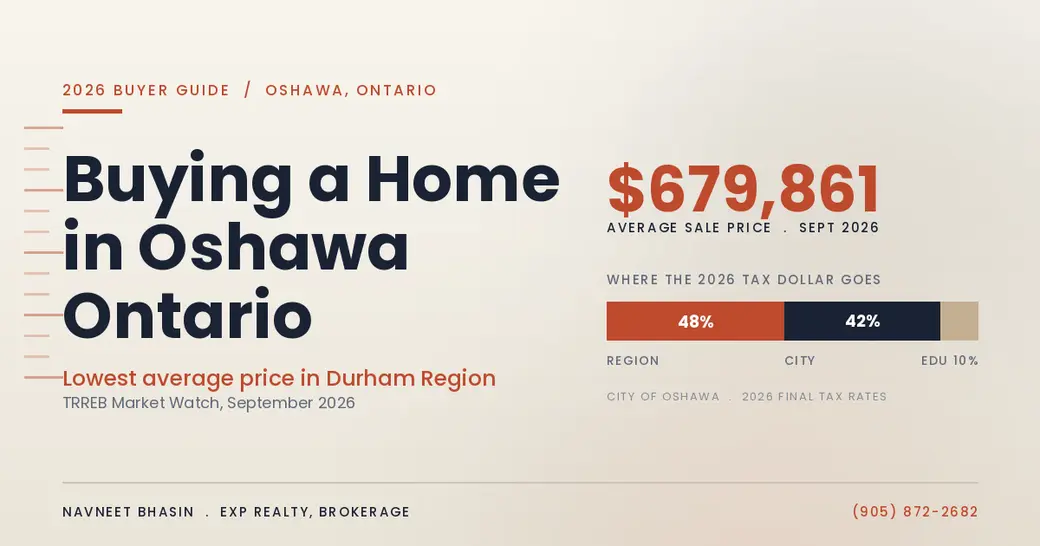
Buying a home in Oshawa Ontario costs less than almost anywhere else in the Greater Toronto Area right now, and the gap is wide enough to change what you can actually afford. Oshawa homes sold for an average of $679,861 in September 2026 against a GTA average of $1,006,409 — a difference of $326,548, or about 32 per cent, according to the Toronto Regional Real Estate Board's September 2026 Market Watch, released 6 October 2026.
I'm Navneet Bhasin, a real estate agent with eXp Realty, Brokerage, working with buyers across Brampton, Mississauga and the wider GTA, Durham Region included. This guide covers what a purchase in Oshawa really costs in 2026 — the price, the property tax rate, the land transfer tax, the qualifying math after the Bank of Canada's October rate increase, and the second-unit rules that decide whether a basement can legally earn income.
Quick answer: what does buying a home in Oshawa Ontario involve in 2026?
Oshawa is the most affordable of Durham Region's five lakeshore municipalities, with an average September 2026 sale price of $679,861 and a median of $653,000 (TRREB, 6 October 2026). It also carries the highest property tax rate of any municipality I work in, a total 2026 residential rate of 1.575342 per cent, and Durham charges no municipal land transfer tax. The trade-off is simple: a lower price and a smaller mortgage, offset by a larger annual tax bill.
Key takeaways
- Oshawa's average sale price was $679,861 in September 2026, the lowest of the five Durham lakeshore municipalities (TRREB, 6 October 2026).
- Oshawa's total 2026 residential property tax rate is 1.575342 per cent, or $1,575.34 per $100,000 of assessed value (City of Oshawa, 2026 final tax rates).
- Durham Region charges no municipal land transfer tax. The same purchase in Toronto would attract a second, roughly equal tax.
- The Bank of Canada raised its policy rate to 2.50 per cent on 28 October 2026, its first increase since July 2023.
- Oshawa permits up to three dwelling units on a lot, subject to parking and zoning rules (Zoning By-law 60-94, section 5.12).
What does buying a home in Oshawa Ontario cost compared with the rest of Durham?
Here is how the five Durham lakeshore municipalities compared in September 2026, with the region and the GTA for context. All figures come from TRREB's Market Watch for September 2026, released 6 October 2026. The final column is derived by dividing new listings by sales — a rough read on how much competition a buyer faces.
| Municipality | Sales | Average price | Median price | New listings | New listings per sale |
|---|---|---|---|---|---|
| Oshawa | 125 | $679,861 | $653,000 | 448 | 3.58 |
| Clarington | 113 | $781,521 | $770,000 | 362 | 3.20 |
| Ajax | 77 | $828,835 | $750,000 | 229 | 2.97 |
| Whitby | 96 | $882,772 | $850,000 | 318 | 3.31 |
| Pickering | 92 | $893,842 | $817,500 | 277 | 3.01 |
| Durham Region | 552 | $828,141 | $770,000 | 1,834 | 3.32 |
| All TRREB areas | 5,040 | $1,006,409 | $860,000 | 16,500 | 3.27 |
Two things stand out. Oshawa is the cheapest entry point in the table by $101,660 against the next municipality up, and it is also the loosest market of the five: 3.58 new listings came to market for every sale, against 3.32 across Durham and 3.27 across the whole TRREB area. That combination favours you, and it is not the normal GTA arrangement.
Why is buying a home in Oshawa Ontario less expensive?
A large part of the answer is the housing stock itself, not any judgement about the city. Oshawa simply has more of the property types that cost less.
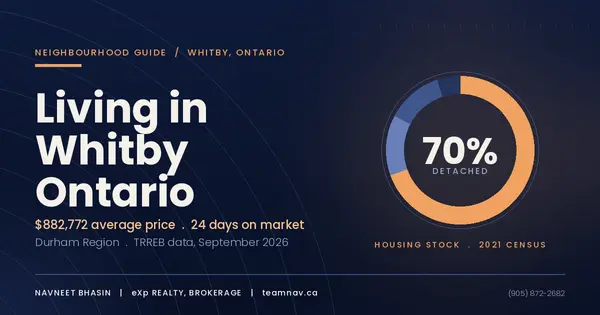
The City's own housing needs assessment reports 2021 Census counts for 66,630 private dwellings: 37,000 single-detached, 7,590 apartments in buildings of five or more storeys, 6,475 in smaller buildings, 6,445 row houses, 5,330 semi-detached and 3,650 apartments in a duplex. Single-detached houses are about 55.5 per cent of the stock and apartments of all kinds about 26.6 per cent; next door in Whitby, single-detached runs to roughly 69.5 per cent.
More apartments, row houses and duplex units means more homes under $600,000, and that pulls the city-wide average down without telling you anything about a particular street.
One caution on that document, because I would rather you heard it from me. Oshawa's housing needs assessment is a federally prepopulated template with no version date and no named preparer, and several of its tables disagree with each other — the structure-type rows above sum to ten more than its own stated total. I cite only its 2021 Census counts.
Two of its counts are worth knowing: tenure in 2021 ran 42,750 owner households to 23,880 renter households, and Oshawa's population was 175,383, up 10 per cent from 159,458 in 2016.
How do Oshawa property taxes change your monthly budget?
This is the part buyers most often miss, and in Oshawa it is big enough to matter. The City of Oshawa's 2026 final tax rates are 0.659196 per cent for the City, 0.763146 per cent for the Region of Durham and 0.153000 per cent for education, totalling 1.575342 per cent.
Put on a common basis of $100,000 of assessed value, here is how that sits against the municipalities I work in most. Rates come from each city's own 2026 table, the Region of Peel's 2026 Property Tax Policy Handbook, and the Town of Milton's published 2026 figure.
| Municipality | Total 2026 residential rate | Tax per $100,000 of assessment |
|---|---|---|
| Oshawa | 1.575342% | $1,575.34 |
| Brampton | 1.253381% | $1,253.38 |
| Mississauga | 1.087901% | $1,087.90 |
| Milton | 0.865220% | $865.22 |
| City of Toronto | 0.767311% | $767.31 |
The City's 2026 budget overview uses an average residential assessment of $356,000. At the total rate, that produces a bill of about $5,608 a year, or roughly $467 a month, and it puts the City's 4.68 per cent levy increase at $107.15 a year on that assessment.
Now the caveat that matters more than any of these numbers. Ontario assessments still use a 1 January 2016 valuation date, and the province has postponed the reassessment again, so your 2026 assessed value equals your 2025 one unless the property itself changed. Do not multiply a tax rate by a purchase price and call it your tax bill — the two numbers are years apart. Ask the seller for the actual bill. I ask for it on every Durham offer I write.
What does the Bank of Canada rate increase mean for buying a home in Oshawa Ontario?
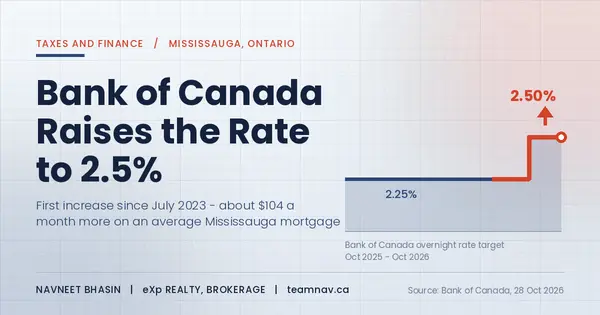
On 28 October 2026 the Bank of Canada raised its policy rate by 25 basis points to 2.50 per cent, its first increase since July 2023, with the Bank Rate at 2.75 per cent. The Bank noted that CPI inflation "has been around 3% since April and is expected to rise to about 3.5% by the end of the year." Governor Tiff Macklem said afterwards that "there could be a need to raise the policy rate further, but given the uncertainties we will proceed carefully." The next scheduled announcement is 9 December 2026.
I am a real estate agent, not a mortgage professional, so this is general information rather than advice about your situation. Here is the scale, which is what buyers ask me for.
Take Oshawa's September average of $679,861 with 20 per cent down — a mortgage of $543,889 on a 25-year amortization, with Canadian semi-annual compounding. Moving from 4.45 per cent to 4.70 per cent takes the payment from about $2,995 to about $3,071 a month: roughly $76 more a month, or $910 a year.
Two things to hold alongside that. The Bank's published table showed a prime rate of 4.45 per cent as of 21 October 2026 and had not yet posted a figure for 28 October, so confirm the current number with your lender. And you do not qualify at your contract rate: OSFI's minimum qualifying rate for uninsured mortgages is the greater of the contract rate plus two percentage points or a 5.25 per cent floor — so 4.70 per cent means qualifying at 6.70 per cent.
What land transfer tax do you pay when buying a home in Oshawa Ontario?
Ontario's land transfer tax applies on closing, calculated on the purchase price under the province's published brackets. On Oshawa's September average of $679,861, the provincial tax works out to about $10,072.
If you have never owned a home anywhere, the first-time buyer refund is worth up to $4,000, bringing that bill down to roughly $6,072. The claim has to be made within 18 months of registration.
Here is the Durham advantage, and it is the cleanest number in this guide. Durham Region charges no municipal land transfer tax. Toronto does, and its municipal tax mirrors the provincial brackets up to $2 million, so the same $679,861 purchase inside Toronto's boundary would attract roughly $20,144 instead of $10,072 — about $10,000 more, in cash on closing day.
Can you add a second unit? Oshawa's accessory apartment rules
For many buyers in this price range, the basement is part of the business case, and Oshawa publishes real detail, so you can check the rules before you write an offer rather than after. According to the City's accessory apartments page, under Zoning By-law 60-94, section 5.12:
- A lot may contain up to three residential dwelling units, and a maximum of one accessory unit may be in an accessory building.
- Accessory apartments are permitted in single detached, semi-detached, duplex and street townhouse dwellings, or in a residential accessory building, in the R1, R2, R3, R5 and several open-space and agricultural zones.
- Parking is the rule that trips people up. Two units require three spaces; three units require four. Each must be 2.75 m by 5.75 m, and most must have unobstructed direct street access rather than sitting in tandem.
- An accessory apartment inside an existing accessory building is capped at 60 square metres, under section 5.12.1(q), which applies to accessory buildings existing as of 29 May 2023.
- A unit built under a building permit receives a two-unit house registration certificate within 60 days of the inspector's final inspection. Units created after July 1994 without a permit need one to be legalized. Drawings must show alarm locations, fire separations and means of egress.
What the City does not publish matters just as much: no minimum unit size, no minimum ceiling height, and no dollar figure for the permit fee. Nothing on that page tells you whether a specific property qualifies, and an existing basement unit in a listing is not the same thing as a registered one. Confirm the status with the City's building department before you count the rent.
Where is Oshawa growing, and how do you get around?
Growth is concentrated downtown and around transit, and both are published. The City's housing page sets out a provincial target of 23,000 new homes by 2031 and waives development charges for new housing in the Downtown Urban Growth Centre. In a statement dated 1 June 2026, Mayor Dan Carter cited 1,600 residential units in the downtown pipeline and a planned population of 46,000 for the Kedron and Columbus communities in the north end.
City-initiated Zoning By-law 75-2025, passed 23 June 2025, frames two Protected Major Transit Station Areas, Central Oshawa and Thornton's Corners, with maximum densities of 300 to 1,000 dwelling units per hectare by zone. Those maximums wait on final approval of Official Plan Amendment 233, so treat them as direction rather than an approved building envelope.
On the ground today, Durham College Oshawa GO sits at 915 Bloor Street West with a main lot of 2,390 spaces. Durham Region Transit fares effective 1 July 2026 are $3.84 for an adult PRESTO tap and $138.24 for a monthly pass, children 12 and under free, and DRT is part of Ontario's One Fare programme, so a connecting trip to or from GO costs nothing extra on PRESTO. The Region of Durham describes a 36-kilometre Durham-Scarborough Bus Rapid Transit project along Highway 2 and a GO Lakeshore East extension to Bowmanville with four new stations, but publishes no funding or construction dates for either.
One practical note if you're moving from Peel: Durham Student Transportation Services uses a flat pair of busing thresholds, more than 1.6 km for the elementary panel and more than 3.2 km for secondary, where Peel's scale starts at 1.0 km for kindergarten. Only the boards can confirm which school an address attends.
Frequently asked questions about buying a home in Oshawa Ontario
Is Oshawa the cheapest place to buy in Durham Region?
Yes, on the September 2026 numbers. Oshawa's average sale price of $679,861 and median of $653,000 were the lowest of the five lakeshore municipalities, with Clarington next at $781,521 (TRREB, 6 October 2026). Figures move month to month, so ask for the current month before you set a budget.
Why are Oshawa property taxes higher than in Brampton or Mississauga?
Oshawa's total 2026 residential rate is 1.575342 per cent, against 1.253381 per cent in Brampton and 1.087901 per cent in Mississauga. Roughly 48 per cent of an Oshawa bill funds Region of Durham services, 42 per cent the City and 10 per cent education. Rates reflect each municipality's budget and assessment base, not property quality.
Do first-time buyers get help with closing costs in Oshawa?
Ontario's first-time buyer land transfer tax refund is worth up to $4,000 and must be claimed within 18 months of registration. Because Durham Region charges no municipal land transfer tax, Oshawa buyers also avoid the second tax Toronto buyers pay. Speak with a real estate lawyer about your own eligibility.
How long do homes take to sell in Oshawa?
Oshawa homes averaged 34 days on market in September 2026, compared with 24 days in Whitby and 23 in Clarington (TRREB, 6 October 2026). With 3.58 new listings per sale against 3.27 across the GTA, buyers generally have more time and more choice than in tighter Durham municipalities.
Can I rent out a basement apartment in an Oshawa house?
Oshawa permits up to three residential dwelling units on a lot under Zoning By-law 60-94, section 5.12, subject to zone, parking and building requirements. An existing unit is not automatically a registered one. Confirm status and permit history with the City's building department before relying on rental income.
Thinking about buying a home in Oshawa Ontario?
Oshawa gives you three things that rarely appear together: the lowest average price in Durham Region, more listings per sale than the GTA as a whole, and no municipal land transfer tax. What it asks in return is a higher annual tax bill, so compare Oshawa against Brampton or Mississauga on total monthly carrying cost rather than on sale price alone.
The second-unit question is worth settling before you offer, not after. So is the actual tax bill on the actual property, which no rate table can tell you.
If you're weighing a move to Oshawa or anywhere in Durham Region, I'd be glad to run those numbers with you on specific properties. Schedule a free consultation or call me at (905) 872-2682.
Navneet Bhasin is a GTA real estate agent with eXp Realty, Brokerage, helping buyers and sellers across Brampton, Mississauga, Toronto and the surrounding region. He's known for an upfront, honest approach and sharp negotiation, with 150+ five-star Google reviews.
This article is general information, not financial, mortgage, legal or tax advice. Market figures are as of the dates cited and change month to month. Consult a mortgage professional, a real estate lawyer and a tax professional about your own circumstances.
Categories
Recent Posts