
Moving to Milton from Mississauga: 2026 Guide
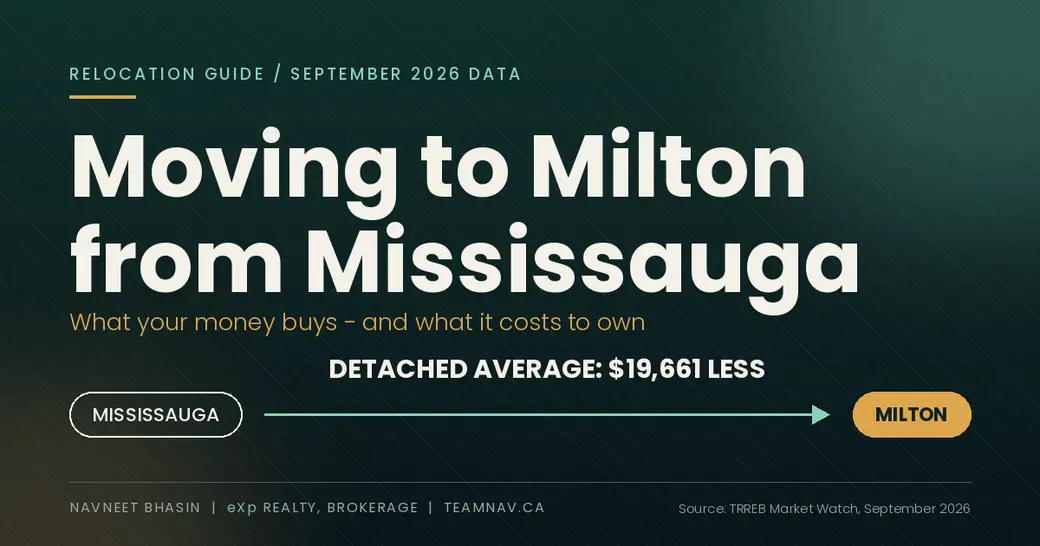
If you're moving to Milton from Mississauga, the honest headline is that you probably won't pay less overall, but you will likely get a bigger house and a noticeably smaller property tax bill. In September 2026, Milton's average sale price across all home types was actually higher than Mississauga's. The detached houses underneath those averages tell the opposite story. I'm Navneet Bhasin, a real estate agent with eXp Realty, Brokerage, and I've walked a lot of Mississauga families through this exact move. Here's what the numbers show, what changes on day one, and what nobody warns you about.
Quick answer: what changes when you move from Mississauga to Milton?
Moving to Milton from Mississauga trades a built-out city of roughly 718,000 people for a town the Province expects to reach 400,000 residents by 2051. In practice that means more freehold and family-sized housing stock, a property tax rate about 20 per cent lower per dollar of assessment, one GO line instead of three, and a town still adding subdivisions rather than filling in. Prices are not dramatically lower; the housing type you get for the money is different.
Key takeaways
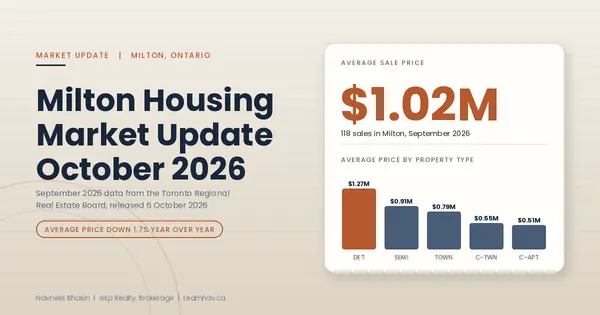
- Milton's average sale price across all home types was $1,018,973 in September 2026 against Mississauga's $929,600 - but Milton's average detached price ($1,265,806) was about $19,661 lower than Mississauga's ($1,285,467), according to the Toronto Regional Real Estate Board's Market Watch report released 6 October 2026.
- The biggest real saving is in freehold townhouses: $785,542 in Milton versus $980,037 in Mississauga that month.
- On property tax, Milton's 2026 blended rate works out to $865.22 per $100,000 of assessed value against Mississauga's $1,087.90 - a difference of about $222.68 per $100,000.
- Milton has one GO rail station and 12 local transit routes, all of which begin and end at it. Route 21 Steeles links Milton GO directly to Lisgar GO in Mississauga.
- Halton's school busing rule is a single distance threshold, not the graduated one Peel families are used to.
What will your money actually buy in Milton versus Mississauga?
Start with the same month's numbers for both municipalities. These come from the Toronto Regional Real Estate Board (TRREB) Market Watch report for September 2026, released 6 October 2026.
| Home type | Milton average | Mississauga average | Difference |
|---|---|---|---|
| All home types | $1,018,973 | $929,600 | Milton +$89,373 |
| Detached | $1,265,806 | $1,285,467 | Milton -$19,661 |
| Semi-detached | $907,157 | $870,161 | Milton +$36,996 |
| Freehold townhouse | $785,542 | $980,037 | Milton -$194,495 |
| Condo apartment | $506,400 | $500,192 | Milton +$6,208 |
Read that table carefully, because it is the whole move in one picture. The all-types line says Milton is more expensive. Every line that describes an actual house says something closer to "about the same, except townhouses."
The freehold townhouse gap is the one I point out most often. Nearly $195,000 separated the two averages in September. Milton sold 33 freehold townhouses that month; Mississauga sold 13. That is a town with a deep, recently built supply of them against a city where the equivalent product is scarcer and older.
A caution on the thin lines: Milton recorded only 10 condo apartment sales and four condo townhouse sales in September 2026. Four sales is not a market average, it's four transactions. Don't plan a purchase around it.
Why is Milton's average price higher when its detached homes cost less?
Because the two municipalities sold completely different mixes of housing that month, and the all-types average is just a weighted blend of whatever happened to trade.
Of Milton's 118 September sales, 63 were detached and 33 were freehold townhouses - about 81 per cent of the market in two freehold categories. Of Mississauga's 468 sales, 122 were condo apartments, averaging $500,192. Those condo sales pull Mississauga's blended average down hard. Milton barely has them to pull with.
So when you see a headline saying Milton is pricier than Mississauga, it is describing sales mix, not value. The useful comparison is always type against type.
For context on the wider market the same month: the GTA recorded 5,040 sales, down about nine per cent year over year, at an average price of $1,006,409, down 5.1 per cent, with a median of $860,000. Milton's own year-over-year move was milder - 118 sales against 132 in September 2025, with the average easing from $1,036,162 to $1,018,973, a drop of about 1.7 per cent. Mississauga went from 500 sales at $969,501 to 468 at $929,600, down about 4.1 per cent.
On financing, the Bank of Canada's target for the overnight rate sits at 2.25 per cent as of 27 October 2026, where it has been since a cut from 2.50 per cent on 29 October 2025. The Bank's next scheduled announcement is 28 October 2026, with a Monetary Policy Report, followed by 9 December 2026. If you're rate-shopping this week, that matters.
How much are property taxes in Milton compared with Mississauga?
This is where moving to Milton from Mississauga pays off most reliably, and it's the part buyers consistently underestimate.
The Town of Milton's 2026 budget sets the blended residential figure - Town, Halton Region and education combined - at $865.22 per $100,000 of assessed value, up from $826.00 the year before. The Town portion alone moved from $354.68 to $379.29.
For Mississauga, the Region of Peel's 2026 Property Tax Policy Handbook gives a total 2026 residential rate of 1.087901 per cent, or $1,087.90 per $100,000. Peel breaks that out as City of Mississauga 0.396141 per cent, Region of Peel 0.538760 per cent and education 0.153000 per cent.
On a home assessed at $600,000, that spread is roughly $1,336 a year. Over a decade it's real money.
Two warnings, both important. First, assessed value is not sale price. Ontario assessments still use a 1 January 2016 valuation date, and the Province's reassessment has been postponed again, so your 2026 assessed value equals your 2025 one unless the property itself changed. Never multiply a rate by what you're paying. Ask the seller for the actual tax bill.
Second, Mississauga's stormwater charge arrives separately on the Region of Peel water bill rather than the tax bill, so a straight tax-to-tax comparison slightly understates what a Mississauga household pays.
One cost that doesn't change: neither Halton Region nor Peel Region charges a municipal land transfer tax, so only Ontario's provincial land transfer tax applies on either side of the move. At September's averages that's about $16,854 in Milton and $15,067 in Mississauga. On the detached averages the gap nearly vanishes: roughly $21,791 against $22,184. First-time buyers can claim a refund of up to $4,000, and it must be claimed within 18 months.
What is the commute like after you move to Milton from Mississauga?
Shorter than people fear in the car, and less flexible on the train.
Milton GO Station sits at 780 Main St. E. with 1,468 spaces in its main lot and staffed hours of 5:50 a.m. to 11:30 a.m., Monday to Friday. That's one rail station. Mississauga has stations on three separate corridors. If your household depends on all-day, both-direction train service, this is the single biggest lifestyle change in the move, and it's the one I ask Mississauga clients about first.
Locally, Milton Transit runs Routes 1 through 9B, Route 21 Steeles and an on-demand Route 401 serving the Industrial, Boyne and Derry Green zones. Every route starts and ends at Milton GO Station - a genuinely useful design if you're a transit commuter, and a limitation if you're trying to cross town without passing through it. Service runs weekdays from 5:18 a.m. to 11:48 p.m., Saturdays from 7 a.m. to 7:53 p.m. and Sundays from 7:32 a.m. to 7:53 p.m., with no service on statutory holidays.
Here's the detail most people moving from Mississauga don't know: Route 21 Steeles runs between Milton GO Station and Lisgar GO Station in Mississauga. If you're keeping a job in north Mississauga, that route is worth studying before you choose a neighbourhood.
One more fare note. Ontario's One Fare program lets riders transfer without paying twice, and the agencies it lists are the TTC, GO Transit, MiWay, Brampton Transit, York Region Transit and Durham Region Transit. Milton Transit is not among them. Budget your transfers accordingly rather than assuming your Mississauga habits carry over.
How fast is Milton growing, and what does that mean for a buyer?
Faster than almost anywhere you've lived if you're coming from Mississauga, and in a different direction.
According to the Town of Milton's Housing in Milton page, Milton is projected to reach 400,000 residents by 2051 and will need roughly 88,000 new housing units to get there - about 2,930 a year, split roughly 58,200 low and medium density, 29,400 high density and about 300 in rural or hamlet areas. Milton's provincial housing pledge is 21,000 units by 2031. The Town received $8.4 million through the Building Faster Fund and lists a Housing Accelerator Fund entitlement of $22,418,300.
Two of Milton's Housing Accelerator commitments change what you can do with a lot: four units as-of-right Town-wide, and four storeys as-of-right within 800 metres of Milton Transit lines. If you're an investor or thinking about a secondary suite, read those two lines twice.
Mississauga's trajectory is the mirror image. Its growth forecast is 995,000 people, 343,500 households and 589,990 jobs by 2051, with the latest update received by Regional Council in December 2024, and its provincial share is 120,000 new units. But the city's own 2024 Housing Needs Assessment, version-dated 26 May 2025, records a 2021 Census population of 717,961 - down 3,638, or 0.5 per cent, from 2016. Of its 244,575 households that year, 90,660 were single-detached and 66,830 were apartments in buildings of five storeys or more. Mississauga grows upward now. Milton still grows outward, though not forever: its own Uptown plan around the GO station carries a long-term capacity of about 25,114 residents and 15,040 units, after Halton Region approved Official Plan Amendment No. 70 on 2 August 2022 and Council passed By-law 089-2022 on 12 September 2022.
What about schools and everyday life in Milton?
Two practical shifts, one of which catches almost every family.
Busing works differently. Halton Student Transportation Services, which serves both the Halton District School Board and the Halton Catholic District School Board, uses a single threshold under Operating Procedure HS-1-002, revised March 2026: students in Grades JK to 8 qualify beyond 1.6 km and students in Grades 9 to 12 beyond 3.2 km. Peel's consortium, STOPR, instead steps the distance up by grade - 1.0 km for JK to Grade 1, 1.6 km for Grades 2 to 4, 2.0 km for Grades 5 to 8 and 3.8 km for secondary. So a family with a kindergarten child may find Halton's rule less generous than Peel's, while a Grade 7 student or a high schooler is often better off. Halton measures along the municipal road centre line using the Region's own GIS base map, not a consumer mapping app.
Nothing in this post states which school any address is assigned to. Boundaries change, and only the school boards can confirm an address. Ask them in writing before you commit.
On daily life, the two big municipal recreation complexes are worth knowing by name. The Milton Sports Centre at 605 Santa Maria Blvd. has four arenas, a lap and play pool, a gymnasium, a fitness studio and an indoor walking and running track. The Milton Leisure Centre at 1100 Main Street East has a lap pool, a play pool with a water slide, a sauna, a gymnasium, a fitness studio and a weight room. Beyond them, Milton sits against the Niagara Escarpment, which is the thing Mississauga simply cannot offer: conservation land and escarpment trails within a ten-minute drive of most of the town.
FAQ: moving to Milton from Mississauga
Is Milton cheaper than Mississauga?
Not on the headline average. In September 2026 Milton averaged $1,018,973 across all home types against Mississauga's $929,600, per TRREB. But Milton's detached average was about $19,661 lower and its freehold townhouse average was $194,495 lower. Compare the same housing type, not the blended figure.
How much lower are property taxes in Milton?
Milton's 2026 blended rate is $865.22 per $100,000 of assessed value, from the Town's 2026 budget, against Mississauga's $1,087.90 from the Region of Peel's 2026 handbook - about $222.68 less per $100,000. On a $600,000 assessment that's roughly $1,336 a year. Assessed value is not sale price.
Can I commute from Milton to Mississauga without a car?
Yes, with planning. Milton Transit's Route 21 Steeles connects Milton GO Station to Lisgar GO Station in Mississauga, and every Milton route begins and ends at Milton GO. Milton has one rail corridor against Mississauga's three, so check your specific trip before choosing a neighbourhood.
Is Milton still building new homes?
Heavily. The Town of Milton projects 400,000 residents by 2051 and about 88,000 new units to serve them, with a provincial pledge of 21,000 units by 2031. It also permits four units as-of-right across the Town and four storeys as-of-right within 800 metres of Milton Transit lines.
What should I ask a seller before buying in Milton?
Ask for the actual property tax bill rather than applying a rate to the price, since Ontario assessments still use a 1 January 2016 valuation date. Ask about the lot's secondary-suite potential given the four-unit permission, and confirm school assignment in writing with the board.
Thinking about moving to Milton from Mississauga?
Two things to take away. The all-types average price makes Milton look more expensive than Mississauga, and the by-type numbers show that's a mix effect, not value - detached is close to a wash and freehold townhouses are meaningfully cheaper. And the property tax difference, roughly $222.68 per $100,000 of assessment in 2026, is the saving that shows up every single year you own.
What the numbers can't tell you is which Milton neighbourhood fits how your household actually lives, how far your commute really is from a given street, or whether a particular lot supports the suite you're planning.
That's the part I do. If you're weighing a move from Mississauga to Milton, schedule a free consultation and we'll go through pricing, taxes and commute side by side for your specific situation. You can also reach me directly at (905) 872-2682.
Navneet Bhasin, eXp Realty, Brokerage - serving Brampton, Mississauga, Milton and the Greater Toronto Area. Navneet has spent years helping buyers and sellers across the GTA and is known for an upfront, honest approach and a current, detailed read of the market.
This post is general information, not legal, tax or financial advice. Speak with a real estate lawyer or a tax professional about your own situation.
Categories
Recent Posts