
Property Taxes in Brampton: What Homeowners Pay in 2026
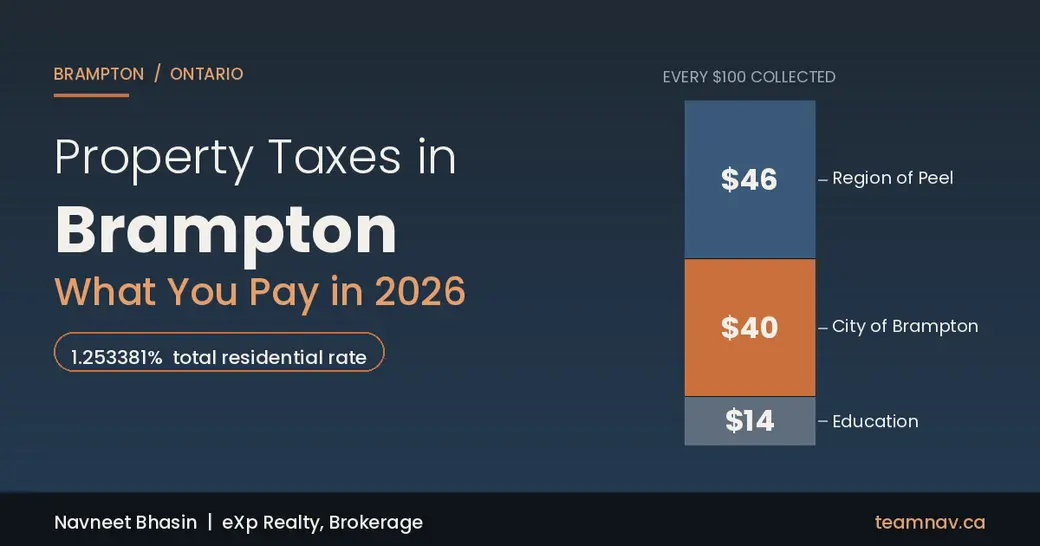
A home in Brampton with a current value assessment of $500,000 pays roughly $6,267 in property taxes for 2026, based on the city's total residential rate of 1.253381%. That rate is three bills rolled into one: the City of Brampton, the Region of Peel, and the province's education levy.
I am Navneet Bhasin, a real estate agent with eXp Realty, Brokerage, and I get asked about property taxes in Brampton at almost every listing appointment. The confusion is fair. The bill arrives twice a year, the number on it has no obvious relationship to what the house is worth, and the rate is set in three different places. Here is how it actually works in 2026.
Key takeaways
- Brampton's total 2026 residential rate is 1.253381%, per Peel Region's Property Tax Policy Handbook (August 2026).
- The 2026 budget delivered a 0% increase to the City's own portion, plus a 1% hospital levy, worth about $73 on an average home (City of Brampton, 6 February 2026).
- Your assessment still uses a 1 January 2016 valuation date. Ontario's reassessment was postponed again, so your 2026 assessed value matches your 2025 one unless the property changed.
- 2026 instalments were due 18 February, 18 March and 22 April (interim) and 22 July, 19 August and 23 September (final).
- Low-income seniors and low-income persons with disabilities can apply for a $590 rebate for the 2026 tax year, with a 31 December deadline.
How is a property tax bill in Brampton calculated?
Quick answer: Your Brampton property tax bill is your property's current value assessment, set by the Municipal Property Assessment Corporation, multiplied by the total residential tax rate for the year. That total rate is the sum of three parts: the City of Brampton's rate, the Region of Peel's rate, and the provincial education rate.
That is the whole formula. There is no separate calculation for your lot size, your bedroom count, or what you paid at closing. Two things drive the number: the assessed value and the rate.
The City collects the full amount but does not keep it. Peel Region publishes the split: of every $100 of property tax collected across the region in 2026, $40 goes to the local municipality, $46 to the Region of Peel, and $14 to education. Most homeowners are surprised the regional share is the largest. Police, paramedics, water and wastewater, waste collection and regional roads all sit on that side of the ledger.
What is the 2026 property tax rate in Brampton?
Peel Region's Property Tax Policy Handbook sets the total residential rate for each of the three Peel municipalities. The education portion, 0.153000%, is set by the province and is identical across Ontario.
| Municipality | 2026 total residential rate | Tax on a $500,000 assessment | Tax on a $700,000 assessment |
|---|---|---|---|
| Brampton | 1.253381% | $6,267 | $8,774 |
| Mississauga | 1.087901% | $5,440 | $7,615 |
| Caledon | 0.982207% | $4,911 | $6,875 |
Rates from the Region of Peel Property Tax Policy Handbook, August 2026. The dollar figures are my own calculation from those published rates, rounded to the nearest dollar.
A higher rate on its own does not mean a heavier tax burden. Rates and assessments move in opposite directions: a municipality with lower assessed values across its housing stock needs a higher rate to raise the same money. Comparing rates without comparing the underlying assessments tells you very little.
What changed in Brampton's 2026 budget?
Brampton Council approved the 2026 budget on 6 February 2026 with no increase to the City's share of the bill. Mayor Patrick Brown said the budget "delivers a 0% increase to the City's portion of the property taxes."
It did keep a 1% hospital levy, dedicated to the reserve for Brampton's second hospital and the City's $125 million commitment to William Osler Health System. Including that levy, the City put the impact at roughly $73 on an average Brampton home.
The regional side moved separately and earlier. Peel Region Council approved its 2026 budget on 11 December 2025 with a 1.53% increase for regional services, 1.77% for Peel Regional Police and 0.06% for other agencies, which the Region described as a 3.36% average total increase.
For comparison, the City of Mississauga reported on 28 January 2026 that its own portion rose 1.61% and the regional portion 3.60%, a total residential increase of 5.21%, or $53.91 for every $100,000 of assessed value.
Why your Brampton assessment is not your home's market value
This is the biggest misunderstanding I run into, and it costs people money when they budget for a purchase. Ontario assessments are still based on a 1 January 2016 valuation date. Peel Region confirms that the 2020 Assessment Update has been postponed again and that 2026 taxes continue to be based on the fully phased-in January 2016 current values. In practice, your 2026 assessed value is the same as your 2025 assessed value unless something changed on the property itself, such as an addition, a new build or a demolition.
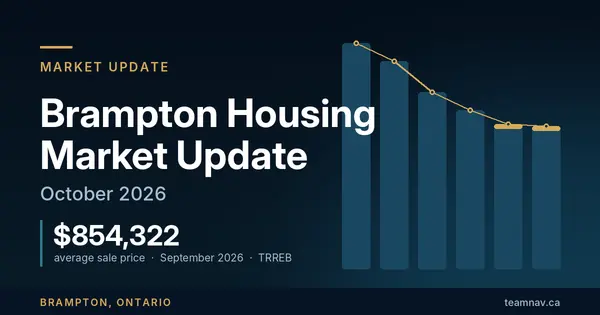
Now put that beside the market. The Toronto Regional Real Estate Board reported an average Brampton sale price of $854,322 across all home types in September 2026. A house selling today for well over $800,000 may carry an assessment set a decade ago at a very different number. Multiply a current asking price by 1.253381% and you will be badly wrong, usually on the high side.
So here is what I tell every buyer in Brampton: ask the seller for the actual current tax bill, in writing, before you finalize your monthly carrying costs.
When are property taxes in Brampton due?
The City bills twice a year, three instalments each. For 2026 the interim bill was due 18 February, 18 March and 22 April; the final bill 22 July, 19 August and 23 September.
The interim bill is not a guess at your new rate. The City calculates it as 50% of the previous year's annual taxes, and the final bill, issued once Council sets the year's rates, trues up the difference. That is why the second half of the year can feel heavier.
If instalments are awkward, the City offers pre-authorized tax payment plans in three forms: monthly at the beginning of the month, monthly at mid-month, or six times a year on the instalment dates. For a household managing cash flow around a mortgage payment, the monthly options help.
What relief and appeal options do Brampton homeowners have?
Three worth knowing about, all through the City of Brampton:
The Property Tax Assistance Program
An annual rebate of $590.00 for the 2026 tax year, adjusted each year by the Toronto consumer price index. You qualify if you are 65 or older and receiving the Guaranteed Income Supplement, or receiving benefits under the Ontario Disability Support Program Act, and have been an assessed owner for at least a year. It must be your principal residence. Applications are due by 31 December of the taxation year and renewed annually.
Tax adjustments under the Municipal Act
Section 357 allows a cancellation, reduction or refund where a property was damaged by fire or demolished, where there is a gross and manifest error in the assessment, or where repairs prevented normal use for at least three months. For the 2026 tax year the City will accept applications until 1 March 2027. Section 358 covers clerical or factual errors going back up to two years, filed between 1 March and 31 December, with a $30.00 fee per year.
Disputing the assessment itself
If you believe the assessed value is wrong, that is an MPAC matter, not a City one. File a Request for Reconsideration with the Municipal Property Assessment Corporation; the deadline is printed on your Property Assessment Notice. For residential properties you must complete that step before appealing to the Assessment Review Board, and you then have 90 days from the results letter to file.
What this means when you are buying or selling in Brampton
For buyers, property taxes belong in the carrying-cost conversation from day one, not at the lawyer's office. On a Brampton home assessed at $600,000 that is roughly $7,520 a year, about $627 a month, alongside the mortgage, utilities and insurance. It can change how much house makes sense.
For sellers, have the current tax bill ready before the first showing. Buyers ask, and an exact number builds more confidence than an estimate.
Frequently asked questions about property taxes in Brampton
What is the property tax rate in Brampton for 2026?
The total residential rate is 1.253381%, per Peel Region's Property Tax Policy Handbook published in August 2026. It combines the City of Brampton's portion, the Region of Peel's portion and the provincial education rate of 0.153000%, and is applied to your MPAC assessed value.
Did property taxes go up in Brampton in 2026?
The City of Brampton's own portion did not increase for 2026, though a 1% hospital levy remained, worth about $73 on an average home. The Region of Peel's portion rose, with Peel reporting a 3.36% average total increase across regional services, police and other agencies.
Why is my Brampton assessment lower than what my house is worth?
Because assessments still use a 1 January 2016 valuation date. Ontario postponed its reassessment, so your 2026 value reflects the 2016 market, not today's. The gap between assessed value and current market value is normal and does not mean there is an error on your bill.
How do I pay Brampton property taxes monthly instead of in instalments?
Enrol in one of the City of Brampton's pre-authorized tax payment plans. There are three schedules: monthly at the beginning of the month, monthly at mid-month, or six payments a year on the regular instalment dates. Contact the City's property tax office to set one up.
Can I appeal my Brampton property tax bill?
You cannot appeal the tax rate, which Council sets. You can challenge the assessed value through a Request for Reconsideration with MPAC, and you can apply to the City for an adjustment under Section 357 or 358 of the Municipal Act where damage, demolition or a clerical error applies.
Getting the numbers right before you buy or sell
Property taxes in Brampton are not complicated once you separate the three pieces: an assessment frozen at 2016 values, a rate set each year by three different bodies, and one bill the City collects on everyone's behalf. What trips people up is assuming the assessment tracks the market.
If you are weighing a move within Brampton, or comparing it against Mississauga or Caledon, I am happy to pull the actual annual tax figures on specific properties so you compare real dollars instead of percentages. Schedule a free consultation or call me at (905) 872-2682.
Navneet Bhasin is a GTA real estate agent with eXp Realty, Brokerage, serving Brampton, Mississauga, Toronto and the surrounding region, with more than 150 five-star Google reviews. Reach him at (905) 872-2682 or teamnav.ca. This article is general information, not legal, tax or financial advice; confirm your own situation with the City of Brampton and a tax professional.
Categories
Recent Posts