
How to Price Your Home in Mississauga: Fall 2026

Knowing how to price your home in Mississauga this fall comes down to one test: the right asking price is the one a buyer with three other options will still choose. That sounds obvious until you look at what buyers are choosing from. Mississauga had 1,371 new listings against 468 sales in September 2026, and across the Greater Toronto Area homes sold for an average of 98% of asking (Toronto Regional Real Estate Board, Market Watch, September 2026). I'm Navneet Bhasin, a real estate agent with eXp Realty, Brokerage, and most of my work is on the selling side. Here's the method I use, what today's numbers support, and the pricing mistakes I keep watching sellers make.
Quick answer: To price a home in Mississauga in fall 2026, start from sold comparables in your own neighbourhood and your own property type from the last 60 days, adjust for condition, lot and exposure, then set the asking price at or just below what those sales support. With GTA homes selling at an average of 98% of asking and roughly three new Mississauga listings coming up for every one sale, a price set above recent solds does not invite competition. It just sits.
Key takeaways
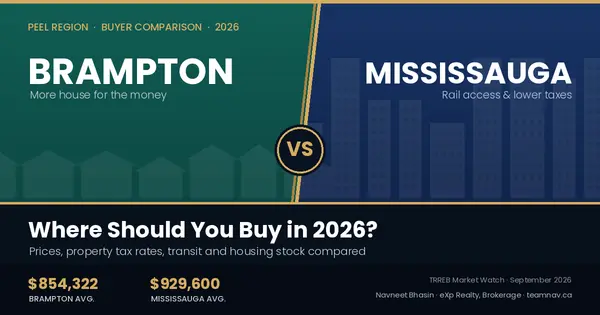
- Mississauga's average selling price was $929,600 in September 2026, down about 4.1% from $969,501 in September 2025 (TRREB Market Watch).
- New listings in Mississauga fell 19.9% year over year, to 1,371 from 1,711 — fewer competitors than last fall, but still close to three new listings per sale.
- GTA homes sold at an average of 98% of list price in 34 days on market, so the market is correcting asking prices rather than bidding them up.
- Your MPAC assessment is not your market value. Ontario assessments still use a 1 January 2016 valuation date.
- Competition varies sharply by property type: Mississauga semi-detached homes had about 2.0 new listings per sale, condo townhouses about 3.3.
What does the Mississauga market actually look like this fall?
Pricing advice is worthless without current numbers. These are Mississauga's September figures, year over year, from TRREB's Market Watch reports.
| Mississauga, all home types | September 2026 | September 2025 | Change |
|---|---|---|---|
| Sales | 468 | 500 | −6.4% |
| Average selling price | $929,600 | $969,501 | −4.1% |
| New listings | 1,371 | 1,711 | −19.9% |
Source: TRREB Market Watch, September 2026 and September 2025. Percentage changes calculated from those figures.
Across the whole TRREB area, September 2026 brought 5,040 sales (down 9% year over year), an average price of $1,006,409 (down 5.1%) and 16,500 new listings (down 14.4%). The MLS Home Price Index Composite benchmark was down 4.7%, and months of inventory sat at 4.6.
Read those together and the story is clear: both sides pulled back, and supply pulled back harder than demand. That is why prices softened without collapsing. TRREB's chief information officer, Jason Mercer, put the demand side this way in the 6 October 2026 release: "We know there is substantial pent-up demand in the GTA." Buyers are watching, but they are not reaching.
Borrowing costs are part of why. The Bank of Canada's target for the overnight rate has been 2.25% since 29 October 2025, with the next announcement scheduled for 28 October 2026. Rates have stopped moving, which removes the excuse buyers used all last year to wait — and the tailwind sellers were counting on.
How to price your home in Mississauga: a four-step method
1. Start with solds, not listings
Every seller I meet has looked at what the neighbours are asking. Asking prices are opinions; sold prices are evidence. I pull every comparable sale in the immediate area from the last 60 days — in a market where the average price moved more than 4% in a year, anything older is history.
2. Narrow to your property type and your pocket
Mississauga is not one market. A semi in Churchill Meadows, a bungalow in Lorne Park and a one-bedroom on the Hurontario corridor answer to entirely different buyer pools. A comparable has to match property type, approximate square footage and neighbourhood — not just the first three characters of the postal code.
3. Adjust honestly for condition
This is where pricing conversations get uncomfortable, and where I earn my keep. A twenty-year-old kitchen, a roof near the end of its life, or outdated wiring in an older Mineola or Cooksville home are all real dollars off the comparable. Buyers price those repairs into their offer whether or not the seller priced them into the list.
4. Pick a number you can defend
If I can't explain your asking price with three sold comparables, it is the wrong price. That is the whole test. Sellers sometimes ask me to "try" a higher number for two weeks. In a 98%-of-asking market those two weeks are not free — which brings us to the real cost of guessing high.
Why does overpricing cost more in Mississauga than it used to?
In September 2026, GTA homes took an average of 34 days on the current listing to sell, and 51 days counting earlier listing attempts on the same property (TRREB Market Watch, September 2026). The gap between those two numbers is the cost of a failed first price. Relisting resets the public days-on-market count; it does not reset buyer memory, or the agent community's.
A listing that starts high follows a predictable path. It gets its best traffic in the first ten days — exactly when it is priced wrong — so it converts none of it. Showings thin out. The seller reduces, usually by too little. By the time the price is right the property is no longer new, and buyers who see a long history read it as a problem rather than a bargain.
The alternative is not underpricing. It is pricing at the evidence and letting a concentrated first week of showings produce competing offers if the market has them to give. That is the only mechanism that gets a seller above asking.
Does your MPAC assessment tell you what your Mississauga home is worth?
No, and this is the single most common pricing mistake I correct. Ontario's property assessments are still based on a 1 January 2016 valuation date, because the province has postponed the reassessment again — the Region of Peel confirms that 2026 assessments continue to use the 2016 base values.
So your Current Value Assessment describes a Mississauga that existed a decade ago. Some sellers see a low assessment and assume their home is worth less than it is; others anchor to a high one. Neither is useful. The assessment exists to allocate property tax — for 2026 the total residential rate in Mississauga is 1.087901% (Region of Peel 2026 Property Tax Policy Handbook). Use it to budget your tax bill, not to set your list price.
How to price your home in Mississauga by property type
Here is the number I find most useful and almost nobody looks at: how many new listings came up for every sale, by property type. It is a rough read on how much competition your buyer had, calculated from TRREB's September 2026 Mississauga figures.
| Property type | Sales | Average price | New listings | New listings per sale |
|---|---|---|---|---|
| Detached | 196 | $1,285,467 | 589 | 3.0 |
| Semi-detached | 72 | $870,161 | 142 | 2.0 |
| Condo townhouse | 61 | $717,408 | 201 | 3.3 |
| Condo apartment | 122 | $500,192 | 382 | 3.1 |
Source: sales, average price and new listings from TRREB Market Watch, September 2026; new listings per sale calculated from those columns. Mississauga's attached/row/townhouse category recorded only 13 sales that month — too thin a sample to conclude anything from — so I've left it out.
In practice: semi-detached sellers had the least competition of any Mississauga category in September, at roughly two new listings per sale, and can price with more confidence. Condo townhouse and condo apartment sellers faced three or more fresh listings per sale, often in the same complex, where a buyer compares your unit against a neighbour's on square footage and maintenance fees in about four minutes. In stacked inventory like that, a price 3% high is not ambitious — it is invisible.
What else moves the number in Mississauga?
Three things a comparables spreadsheet alone will not catch.
The Hurontario corridor and the LRT. The Hazel McCallion Line is an 18-kilometre light rail route with 19 stations and stops, from Port Credit GO up Hurontario to Brampton Gateway Terminal. Metrolinx has not published a confirmed in-service date and the line is not yet running. Near the alignment that cuts both ways: buyers value future transit and discount for live construction outside the window. Price the street as it is today, not as the rendering.
Where in the city you are. Port Credit, Lorne Park, Mineola and Clarkson trade on mature lots and proximity to the Lakeshore GO corridor. Churchill Meadows, Lisgar and Meadowvale trade on newer housing stock and school proximity. City Centre trades on amenities within walking distance. The same square footage carries very different numbers in each, and a comparable from the wrong pocket of Mississauga leads straight to a price reduction.
Fall itself. Daylight is the underrated variable. By late October a 5 p.m. showing in Mississauga happens in the dark, so interior lighting and exterior photos taken while leaves are still on the trees matter more than they do in June — which is why I book photography early in the listing week. The rest of the fall checklist is short: clear the gutters, service the furnace so the inspection comes back clean, and clear wet leaves off the walkway before every showing.
Can you tell buyers what the other offers say?
Sellers ask me this constantly, and the Ontario answer changed in 2023. Under the Trust in Real Estate Services Act, your agent must tell everyone who submitted a written offer how many competing written offers exist — automatic, no permission needed from you. The contents are different: terms such as a closing date, a condition or the price may be shared only on your written direction, and then the same information must go to everyone who has made an offer. You can change that direction at any point. Anything identifying the person behind an offer can never be shared (Real Estate Council of Ontario, information bulletin on competing offers, effective 1 December 2023). It is a tactical call, and worth deciding before offer night rather than during it.
Frequently asked questions
What is the average home price in Mississauga right now?
Mississauga's average selling price across all home types was $929,600 in September 2026, down roughly 4.1% from $969,501 a year earlier, according to TRREB's Market Watch reports. By type, detached homes averaged $1,285,467 and condo apartments $500,192. Your own value depends on neighbourhood, type and condition.
Should I sell my Mississauga home now or wait until spring?
It depends on whether you are also buying. Spring brings more buyers but also far more competing listings. This fall, Mississauga new listings were down 19.9% year over year, so there is less competition now. If you are selling and buying in the same market, the two moves largely offset. Let's look at your specific situation.
How long does it take to sell a home in Mississauga?
Across the GTA in September 2026, homes sold in an average of 34 days on the current listing, and 51 days counting previous listing attempts on the same property (TRREB Market Watch). That gap is mostly made up of homes that launched at the wrong price and had to be relisted. Correct pricing shortens it.
Is my MPAC assessment a reliable guide to my asking price?
No. Ontario Current Value Assessments still use a 1 January 2016 valuation date because the province has postponed the reassessment, as the Region of Peel confirms. The assessment allocates your property tax bill; it does not reflect what a buyer will pay in 2026. Use recent sold comparables instead.
What does it cost to sell a home in Ontario?
Sellers typically budget for real estate commission, legal fees and disbursements, any required repairs, and mortgage discharge or penalty costs if applicable. Ontario land transfer tax is paid by the buyer, not the seller. There are also tax reporting obligations on a property sale, so speak with a tax professional before you close.
Getting your Mississauga price right
Three things to carry away. Sold comparables from the last 60 days in your own property type are the only real evidence of value. Your MPAC assessment, built on 2016 values, is not. And in a market where the average home sells at 98% of asking in 34 days, the first ten days of your listing are the asset you are managing — which makes the opening price the most consequential decision of the whole sale.
If you're thinking about selling in Mississauga this fall or next spring, I'll give you an honest number backed by comparables, not the number you want to hear. Schedule a free consultation or call me at (905) 872-2682 and we'll walk your home together.
Navneet Bhasin is a GTA real estate agent with eXp Realty, Brokerage, who has spent years helping buyers and sellers across Brampton, Mississauga, Toronto and the surrounding region. He's known for an upfront, honest approach, sharp negotiation, and a deep, current understanding of the GTA market, and he has earned 150+ five-star Google reviews from clients. Reach him at (905) 872-2682 or teamnav.ca.
Categories
Recent Posts