
Brampton vs Mississauga: Where Should You Buy in 2026?
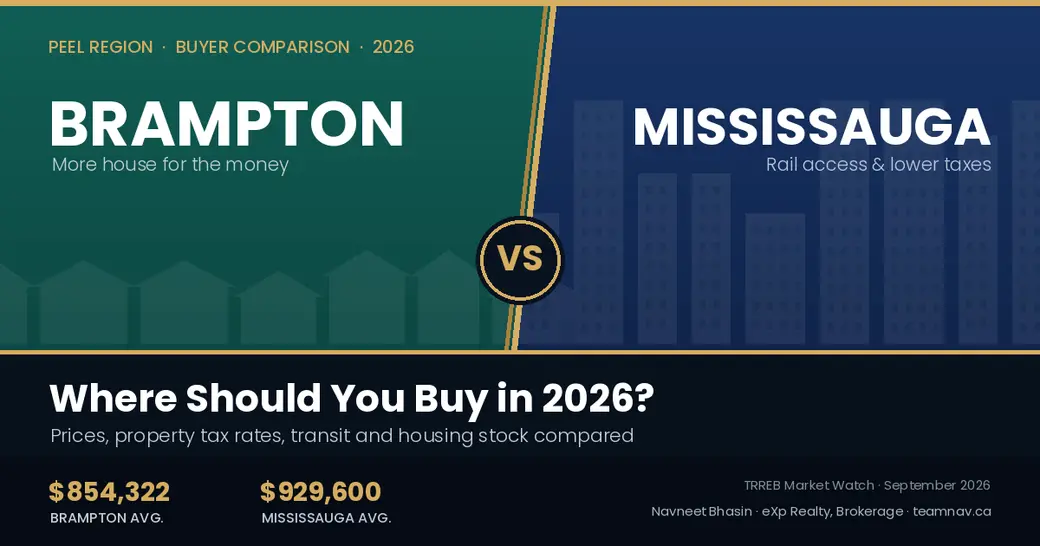
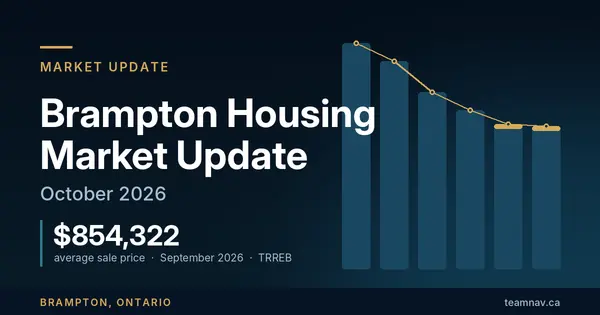
If your budget is the deciding factor, buy in Brampton. If your commute is, buy in Mississauga. That's the short version of the Brampton vs Mississauga question I get asked most often, and the September 2026 numbers back it up: the average Brampton home sold for $854,322 last month compared with $929,600 in Mississauga, according to the Toronto Regional Real Estate Board's Market Watch report released 6 October 2026.
I'm Navneet Bhasin, a real estate agent with eXp Realty, Brokerage, and I work on both sides of the Mississauga Road boundary every week. The two cities sit in the same region, share the same school boards and the same police service, and are separated in places by a single street. They are not interchangeable. Below is the comparison I walk my clients through, with every figure sourced and dated.
Quick answer: Brampton and Mississauga are neighbouring cities in Peel Region, Ontario. Brampton is the more affordable of the two across every property type but carries a higher property tax rate, while Mississauga costs more up front, taxes less, and offers faster rail access to downtown Toronto plus a much deeper condo market.
Key Takeaways
- The average Brampton home sold for $854,322 in September 2026 versus $929,600 in Mississauga, a gap of roughly $75,000 (TRREB Market Watch, September 2026).
- A detached house averaged $1,001,613 in Brampton and $1,285,467 in Mississauga last month — a difference of about $284,000, or 28 per cent.
- Brampton's 2026 total residential property tax rate is 1.253381 per cent against Mississauga's 1.087901 per cent, per Peel Region's 2026 Property Tax Policy Handbook.
- Condo apartments made up about 26 per cent of Mississauga's September sales but under 9 per cent of Brampton's, so the two cities suit very different budgets and lifestyles.
- Prices softened more in Brampton over the past year (down 8.0 per cent) than in Mississauga (down 4.1 per cent), which has narrowed the gap between them.
What's the price difference between Brampton and Mississauga right now?
Mississauga costs more in every single property category. Here's how September 2026 average sale prices compared, drawn from TRREB's municipal tables.
| Property type | Brampton | Mississauga | Difference |
|---|---|---|---|
| All home types | $854,322 | $929,600 | $75,278 |
| Detached | $1,001,613 | $1,285,467 | $283,854 |
| Semi-detached | $778,223 | $870,161 | $91,938 |
| Freehold townhouse | $737,900 | $980,037 | $242,137 |
| Condo townhouse | $548,813 | $717,408 | $168,595 |
| Condo apartment | $422,389 | $500,192 | $77,803 |
Source: TRREB Market Watch, September 2026
One line in that table matters more than the rest. A freehold townhouse in Mississauga averaged $980,037 last month — within about $22,000 of what a fully detached house averaged in Brampton. If your heart is set on a driveway, a backyard and no shared walls, Brampton is where that becomes realistic on a mortgage most households can carry.
The gap has also been closing. Brampton's average price fell 8.0 per cent from September 2025's $928,542, while Mississauga slipped 4.1 per cent from $969,501. Across the region, TRREB reported 5,040 GTA sales in September 2026, down 9 per cent year over year, with the MLS Home Price Index composite benchmark down 4.7 per cent and 4.6 months of inventory.
In my experience, that combination — softer prices and more inventory than we saw two years ago — gives buyers room to negotiate conditions, not just price. Financing and inspection conditions are being accepted in both cities again.
Which city has lower property taxes, Brampton or Mississauga?
Mississauga, and the gap is real money. Peel Region's 2026 Property Tax Policy Handbook sets the total residential rate at 1.253381 per cent in Brampton, 1.087901 per cent in Mississauga and 0.982207 per cent in Caledon. Each total combines the local city levy, the Peel Region levy and the province's education levy of 0.153 per cent.
Run those rates against the $579,400 assessed value Peel Region uses in its own residential example and the annual bill works out to roughly $7,262 in Brampton versus $6,303 in Mississauga — a difference of about $959 a year.
Two things about that calculation catch buyers off guard, and I bring them up before anyone writes an offer.
First, your tax bill is not based on what you pay for the house. It's based on your Current Value Assessment from the Municipal Property Assessment Corporation, and Peel Region confirms those values still use a 1 January 2016 valuation date because the province has postponed the reassessment again. A home that sells for $1.1 million today may be assessed well below that.
Second, Brampton's higher rate isn't the result of a 2026 increase. City Council adopted its 2026 Budget on 6 February 2026 with a 0 per cent increase to the City's portion of the tax bill, plus a 1 per cent hospital levy that funds Brampton's contribution to the new hospital at Peel Memorial. The City put the combined impact at $73 on an average Brampton home. Mississauga's 2026 residential increase came in at 5.21 per cent in total, with 1.61 per cent from the City and 3.60 per cent from Peel Region, per the Mayor's 2026 residential tax newsletter.
Property tax treatment varies by property and circumstance, so confirm your own numbers with the city and speak to a tax professional before you budget on them.
How do commuting and transit compare in Brampton and Mississauga?
This is where Mississauga pulls ahead, and it's usually the argument that decides things for buyers working downtown.
Mississauga sits on two GO rail corridors. The Lakeshore West line runs through Port Credit and Clarkson with frequent two-way service to Union Station, and the Milton line serves Erindale, Streetsville, Meadowvale and Cooksville. Brampton is served by the Kitchener line, with stations at Brampton, Bramalea and Mount Pleasant, plus Züm bus rapid transit along Queen Street and Steeles Avenue.
The bigger change is still ahead. Metrolinx's Hazel McCallion Line — the 18-kilometre, 19-stop light rail route between Port Credit and Steeles Avenue along Hurontario Street — is now targeted for spring 2028, with construction expected to wrap in early 2028, as Global News reported on 28 April 2026. Metrolinx has not confirmed a final date publicly, saying one will be announced after the systems integration milestone is complete.
Note where that line stops: Steeles Avenue, the Brampton boundary. The extension deeper into Brampton and the downtown Mississauga loop are both planned but are not part of the spring 2028 target. So if LRT access is part of why you're buying, Mississauga delivers it years earlier.
I tell clients to drive their actual commute at their actual departure time before choosing between the two cities. A Mount Pleasant address with a short walk to the GO platform can beat a Mississauga address that needs a car trip to the station.
What kind of home will you actually get in each city?
The two markets are built differently, and the sales mix shows it. Of Brampton's 404 September 2026 sales, 234 were detached and only 35 were condo apartments — under 9 per cent. Of Mississauga's 468 sales, 122 were condo apartments, about 26 per cent, with 196 detached.
Brampton is where the GTA's newer freehold inventory sits. Springdale, Mount Pleasant, Credit Valley, Fletcher's Meadow and Sandringham-Wellington are full of detached and semi-detached homes built from the late 1990s onward, with the kind of square footage that's hard to find at the same price in Mississauga. Northwest Brampton has more to come: the City's Heritage Heights Community secondary plan covers one of Brampton's last remaining greenfield areas, bounded by Mayfield Road, Winston Churchill Boulevard, Mississauga Road and the Credit River valley.
Mississauga offers range Brampton doesn't. Square One and the Hurontario corridor give you a genuine high-rise market; Port Credit, Lorne Park, Mineola and Clarkson give you mature lots and lake access; Streetsville and Meadowvale Village give you village-scale main streets. The City is also building out six new parks at Lakeview Village, a 177-acre waterfront redevelopment adding 18.5 hectares of parkland and a Cultural Pier extending 350 metres into Lake Ontario, in phases over the next seven years.
Housing stock, not prestige, is the useful way to compare these cities. Ask what you need under your roof, then look at where that exists.
What do Brampton and Mississauga share?
More than most buyers realise, which is why the differences above carry so much weight.
Both cities are inside Peel Region, so water, wastewater, waste collection, paramedic services and regional roads come from the same place, and both are policed by Peel Regional Police. Both are served by the same two English-language school boards, the Peel District School Board and the Dufferin-Peel Catholic District School Board, so a move across the city line does not mean a move to a different board — though it almost always means a different catchment, which you should confirm with the board directly before you commit.
Both cities also share Pearson airport as an employment anchor, and both feed the same regional job market. You are choosing a cost structure and a commute, not a different world.
Frequently Asked Questions
Is Brampton cheaper than Mississauga?
Yes, in every property category. TRREB's September 2026 figures put Brampton's average sale price at $854,322 against Mississauga's $929,600, with the widest gap in detached homes at roughly $284,000. Brampton's lower purchase price is partly offset by a higher annual property tax rate.
Why are Brampton property taxes higher than Mississauga's?
Both cities pay the same provincial education levy and sit in the same region, but Brampton's municipal levy is higher. For 2026, Peel Region lists Brampton's total residential rate at 1.253381 per cent and Mississauga's at 1.087901 per cent. Brampton also applies a 1 per cent hospital levy funding its second hospital.
Is Mississauga or Brampton better for commuting to downtown Toronto?
Mississauga, generally. It has two GO rail corridors including frequent Lakeshore West service from Port Credit and Clarkson, while Brampton relies on the Kitchener line and Züm bus rapid transit. The Hazel McCallion Line LRT is targeted for spring 2028 and ends at Steeles Avenue, Brampton's border.
Where can you buy a detached home for under $1 million in Peel Region?
Brampton is the realistic answer. Detached homes there averaged $1,001,613 in September 2026, so a meaningful share of listings fall below $1 million, particularly in Bramalea, Heart Lake, Madoc and Northgate. Mississauga's detached average of $1,285,467 puts sub-$1-million detached inventory in much shorter supply.
Will the Hurontario LRT be extended into Brampton?
An extension into Brampton is planned, along with a downtown Mississauga loop, but neither is included in the spring 2028 target for the initial Port Credit to Steeles Avenue route. Metrolinx has not published a confirmed opening date for the extension, so treat it as a long-term factor.
Ready to Compare Brampton and Mississauga for Yourself?
Here's how I'd summarise it. Brampton buys you more house for the money and newer freehold stock, at the cost of a higher annual tax bill and a longer trip to Union Station. Mississauga buys you rail access, a real condo market and lower taxes, and you pay for it up front — most sharply on detached homes.
The right answer depends on your down payment, your commute and whether you need a backyard or a balcony. That's a conversation, not a calculation, and it's the one I have with buyers across Peel Region every week.
If you're weighing Brampton against Mississauga, schedule a free consultation and I'll put current listings in both cities side by side against your budget, including what your tax bill would actually look like in each. Call or text me at (905) 872-2682, or start at teamnav.ca.
Navneet Bhasin is a GTA real estate agent with eXp Realty, Brokerage, serving Brampton, Mississauga, Toronto and the surrounding region. He's known for an upfront, honest approach, sharp negotiation and a current understanding of the GTA market, with more than 150 five-star Google reviews from clients.
Recent Posts