
Brampton Housing Market Update: October 2026
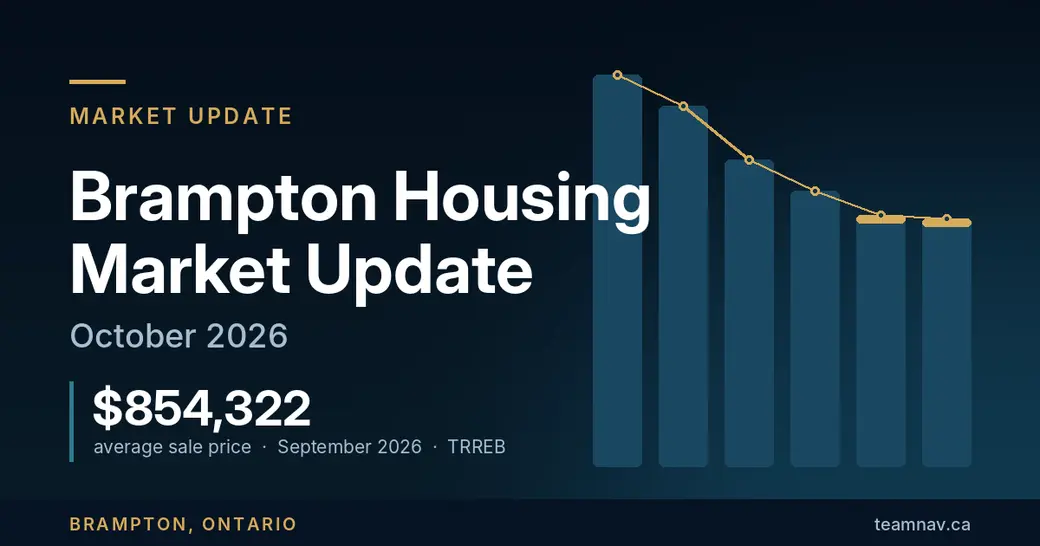
Quick answer: Brampton is a buyer's market heading into late 2026. The average Brampton home sold for $854,322 in September 2026, according to the Toronto Regional Real Estate Board (TRREB) Market Watch report. Inventory sits at roughly 4.4 months of supply, homes are closing at about 97% of asking, and the Bank of Canada has held its policy rate at 2.25% since September 2. Buyers have room to negotiate. Sellers need sharp pricing and real preparation.
I'm Navneet Bhasin, a real estate agent with eXp Realty, Brokerage, and I've spent years working the Brampton housing market street by street. Every fall I get the same question from both sides of the table: has the market turned yet? Here's what September's numbers actually say, and what I'd tell you to do about it. Every figure comes from a named, dated source, and where a number is my own calculation from board data, I say so.
Key Takeaways
- The average Brampton home price was $854,322 in September 2026, with a median of $816,750 (TRREB Market Watch, September 2026).
- Brampton recorded 404 sales against 1,073 new listings and 1,785 active listings — a sales-to-new-listings ratio of about 38%, below the 45–65% range the Canadian Real Estate Association (CREA) calls balanced.
- Detached homes averaged $1,001,613; condo apartments averaged $422,389 — a spread of roughly $579,000 across Brampton's housing stock.
- Brampton's average price ran about 15% below the GTA-wide average of $1,006,409 (TRREB, September 2026).
- The Bank of Canada held its policy rate at 2.25% on September 2, 2026, with its next scheduled decision on October 28, 2026.
What's happening in the Brampton housing market right now?
Prices are soft, supply is ample, and sales are slow but steady.
In September 2026, Brampton saw 404 sales across all home types, with 1,073 new listings arriving and 1,785 properties active at month end (TRREB Market Watch, September 2026). Homes that sold averaged 32 days on market and closed at 97% of the last asking price.
That 97% is the figure I watch most closely. It means the average Brampton seller accepted roughly three percent under asking. Two years ago that gap would have been unusual. Today it's the baseline, and it's the clearest sign negotiating leverage has shifted.
The regional picture matches. Across TRREB's coverage area, September sales came in at 5,040 — down 9.0% year over year — with the average selling price at $1,006,409, down 5.1%. New listings fell 14.4% and active listings fell 9.3%, leaving about 4.6 months of inventory. Supply is thinning, but demand has thinned faster.
Brampton home prices by property type (September 2026)
A single city-wide average hides most of what matters. Brampton's housing stock runs from $400,000 condo apartments to seven-figure detached homes, and those segments aren't moving together.
| Property type | Sales | Average price | Median price | Avg. days on market |
|---|---|---|---|---|
| All home types | 404 | $854,322 | $816,750 | 32 |
| Detached | 234 | $1,001,613 | $930,000 | 31 |
| Semi-detached | 60 | $778,223 | $783,500 | 28 |
| Townhouse (att/row) | 43 | $737,900 | $725,000 | 29 |
| Condo townhouse | 32 | $548,813 | $557,500 | 36 |
| Condo apartment | 35 | $422,389 | $422,000 | 52 |
Source: TRREB Market Watch, September 2026.
Detached homes still carry this market — 234 of 404 sales, roughly 58% of everything that traded — and they crossed back over the million-dollar line at $1,001,613 on average.
Semi-detached is the fastest-moving segment at 28 days. In my experience that's because a well-kept semi in an established pocket like Fletcher's Creek South or Northwood Park lands at a price point buyers can still reach, and only 147 of them were listed all month.
Condo apartments are the slow lane: 52 days on market and 95% of asking, nearly twice as long as a detached home. If you own a Brampton condo and plan to sell, build that timeline in now rather than in February.
How does Brampton compare with Mississauga and the GTA?
| Market | Sales | Average price | Active listings | Avg. days on market |
|---|---|---|---|---|
| Brampton | 404 | $854,322 | 1,785 | 32 |
| Mississauga | 468 | $929,600 | 2,408 | 36 |
| GTA (all TRREB) | 5,040 | $1,006,409 | 26,131 | 34 |
Source: TRREB Market Watch, September 2026.
Brampton's average ran roughly $152,000 below the GTA figure and about $75,000 below Mississauga's — the practical reason buyers keep crossing into Brampton from Mississauga and west Toronto. Brampton also moved faster last month, 32 days versus 36, with fewer active listings competing for attention.
Is Brampton a buyer's or seller's market?
By the standard measures, Brampton favours buyers.
Divide September's 404 sales by its 1,073 new listings and you get a sales-to-new-listings ratio of about 38% (my calculation from TRREB data). CREA describes a ratio between 45% and 65% as generally consistent with a balanced market; below it points to buyers' conditions. Divide 1,785 active listings by 404 sales and you get about 4.4 months of inventory.
What that looks like in the offers I'm writing and receiving:
- Conditional offers are normal again. Financing and inspection conditions aren't deal-breakers.
- Overpriced listings sit. The market won't fix a bad price with a bidding war.
- Well-prepared, correctly priced homes still sell in about a month.
Prices aren't collapsing. The market has returned to ordinary negotiation, where pricing and preparation decide the outcome.
If you're buying, use that leverage specifically: with 4.4 months of inventory you can be selective about condition, lot and location instead of taking whatever clears. If you're selling, price it right the first time — an aspirational price doesn't open a negotiation, it starts a stale listing.
What does the Bank of Canada's rate hold mean for Brampton buyers?
The Bank of Canada held its policy interest rate at 2.25% on September 2, 2026, noting that "following several weak quarters, there was some rebound in housing activity" while flagging increased upside risks to its inflation forecast. Its next scheduled decision is October 28, 2026.
For a Brampton buyer, a steady policy rate buys predictability — you can get pre-approved and plan around it. I won't tell you where rates go next; nobody credible will. But buyers who sort out financing before they shop write the strongest offers in this market. Talk to a licensed mortgage professional about your own numbers.
What will it cost to own in Brampton in 2026?
Brampton City Council adopted its 2026 budget with a 0% increase to the City's portion of the property tax bill, plus a dedicated 1% levy for the city's second hospital reserve. Per the City's news release dated February 6, 2026, the net effect on an average Brampton home is about $73 for the year, with the levy going toward the City's $125 million commitment to William Osler Health System.
Seventy-three dollars won't decide a purchase, but buyers comparing municipalities weigh total cost of ownership, not just the sticker price. Confirm current rates with the City of Brampton and the Region of Peel for the property you're considering, and speak with a tax professional about your own situation.
Frequently asked questions about the Brampton housing market
What is the average home price in Brampton right now?
The average Brampton home sold for $854,322 in September 2026, with a median of $816,750, according to TRREB's Market Watch report. That average spans everything from condo apartments near $422,000 to detached homes above $1 million, so ask for figures on your specific property type and neighbourhood.
Are Brampton home prices going up or down?
Across the GTA, the average selling price fell 5.1% year over year in September 2026 and sales fell 9.0% (TRREB, September 2026). Brampton is moving with that softer regional trend. I don't forecast prices, and no honest agent will guarantee a direction — but today's data shows buyers holding negotiating room.
Is it a good time to buy a house in Brampton?
That depends on your finances and timeline, not the calendar. The data shows real buyer leverage: roughly 4.4 months of inventory, homes selling near 97% of asking, and conditional offers being accepted again. If your financing is secure and you plan to stay several years, those conditions work in your favour.
How long does it take to sell a home in Brampton?
Brampton homes sold in September 2026 averaged 32 days on market (TRREB). It varies sharply by type: semi-detached averaged 28 days, detached 31 days, and condo apartments 52 days. Accurate pricing and pre-listing preparation move that number more than anything else you control.
Is Brampton cheaper than Mississauga?
Yes, on average. Brampton's average sale price was $854,322 in September 2026 compared with $929,600 in Mississauga — a difference of about $75,000 (TRREB, September 2026). Brampton also sat roughly 15% below the GTA-wide average of $1,006,409 that month.
Thinking about buying or selling in Brampton?
Where the Brampton housing market stands going into late 2026: an average price of $854,322, about 4.4 months of inventory, homes selling at 97% of asking in roughly a month, and a policy rate steady since early September. Buyers have genuine negotiating room. Sellers can still do very well — with accurate pricing and real preparation.
City-wide averages won't tell you what your home is worth or what your budget buys on a specific street. That takes a conversation about your property and your timeline.
I'd be glad to have it. Schedule a free consultation or call me directly at (905) 872-2682, and I'll walk you through the numbers for your part of Brampton — honestly, with no sugar-coating.
About the author: Navneet Bhasin is a GTA real estate agent with eXp Realty, Brokerage, serving Brampton, Mississauga, Toronto and the surrounding region, known for an upfront approach, sharp negotiation and 150+ five-star Google reviews. Reach him at (905) 872-2682 or teamnav.ca.
Data sources: TRREB Market Watch, September 2026; Bank of Canada policy rate announcement, September 2, 2026; City of Brampton 2026 Budget news release, February 6, 2026; Canadian Real Estate Association balanced-market benchmark. This article is general information, not financial, tax or legal advice.
Categories