
Moving to Mississauga from Toronto: 2026 Guide
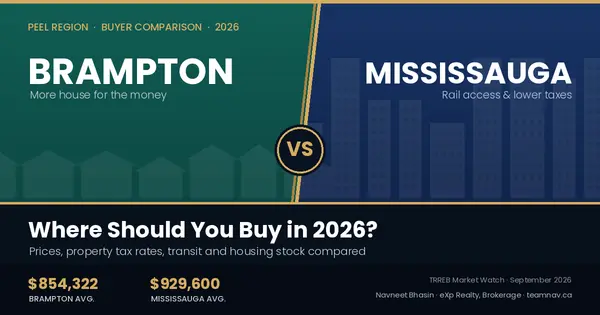
If you are moving to Mississauga from Toronto in 2026, the short version is this: you will pay less at closing, less for the same square footage, and more in annual property tax. In September 2026 the average Mississauga home sold for $929,600 against $1,034,320 in the City of Toronto, and a Mississauga buyer pays no municipal land transfer tax at all. I am Navneet Bhasin, a real estate agent with eXp Realty, Brokerage, and I move clients across the Toronto-Mississauga line most months of the year. Here is what the numbers actually look like right now, what the commute really involves, and the two bills nobody warns you about.
Quick answer: is it cheaper to live in Mississauga than Toronto?
Quick answer: Moving to Mississauga from Toronto lowers your purchase price and your closing costs but raises your annual property tax. Based on Toronto Regional Real Estate Board data for September 2026, Mississauga's average sale price sits about $104,700 below the City of Toronto's, and Mississauga buyers skip Toronto's municipal land transfer tax, which on a $1,000,000 purchase is $16,475. Mississauga's 2026 residential property tax rate, however, is 1.087901% versus Toronto's 0.767311%.
Key takeaways
- Average September 2026 sale price was $929,600 in Mississauga and $1,034,320 in the City of Toronto (TRREB Market Watch, September 2026, released 6 October 2026).
- The detached gap is the widest: $1,285,467 in Mississauga versus $1,562,966 in Toronto for the same month.
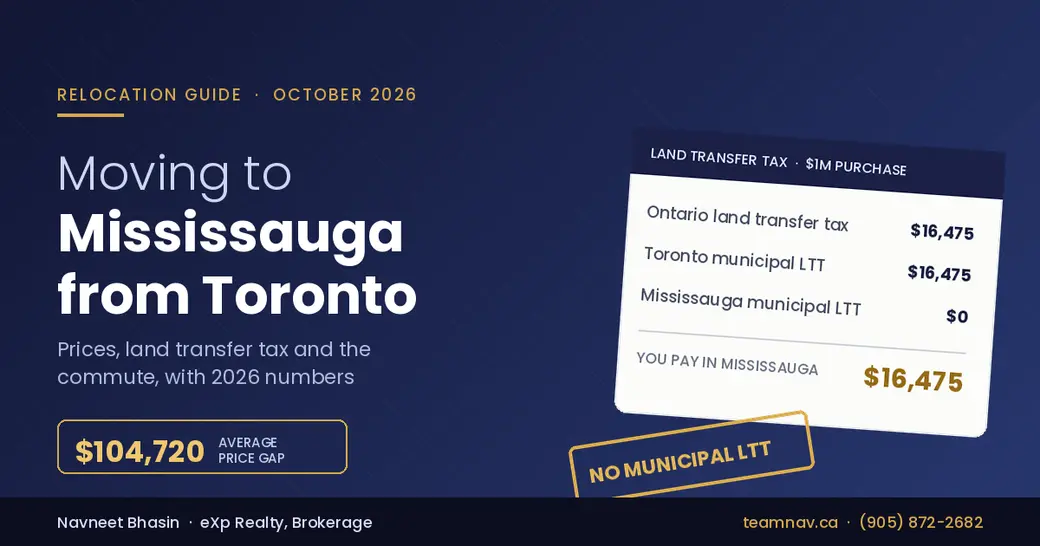
- Mississauga charges no municipal land transfer tax. On a $1,000,000 purchase that is roughly $16,475 you do not pay at closing, calculated from the City of Toronto's published rate schedule.
- Mississauga's 2026 total residential property tax rate is 1.087901% against Toronto's 0.767311%, so the annual bill moves the other way.
- Mississauga adds a stormwater charge on your Region of Peel water bill that Toronto homeowners have never seen, estimated at $64.45 to $219.13 a year for 2026 depending on your rooftop size.
What does moving to Mississauga from Toronto cost per home type?
Averages across a whole city hide the part that matters, which is what your specific housing type costs on each side of the border. These are the September 2026 figures from the Toronto Regional Real Estate Board's Market Watch report, released 6 October 2026.
| Home type | Mississauga average | City of Toronto average | Difference |
|---|---|---|---|
| Detached | $1,285,467 | $1,562,966 | $277,499 |
| Semi-detached | $870,161 | $1,207,884 | $337,723 |
| Condo townhouse | $717,408 | $749,653 | $32,245 |
| Condo apartment | $500,192 | $640,248 | $140,056 |
| All home types | $929,600 | $1,034,320 | $104,720 |
Read the semi-detached row twice. It is the biggest gap on the table, and it is the trade most of my Toronto clients are actually making: leaving a semi on a narrow lot in the old city for a Mississauga detached or a large semi with a driveway that fits two cars without a permit.
The condo townhouse row is the opposite story. At roughly $32,000 apart, a Toronto condo townhouse owner is not buying much more house by moving west. If that is your starting point, the case for the move is about space, parking and schooling, not price.
How much land transfer tax do you save?
This is the line item Toronto sellers forget about until the lawyer's statement of adjustments lands. Ontario charges land transfer tax everywhere in the province. The City of Toronto charges a second one on top, the municipal land transfer tax, and Mississauga does not.
Using the provincial brackets published by the Government of Ontario and the municipal brackets published by the City of Toronto, here is a $1,000,000 purchase on each side of the line.
| Cost on a $1,000,000 purchase | Mississauga | City of Toronto |
|---|---|---|
| Ontario land transfer tax | $16,475 | $16,475 |
| Municipal land transfer tax | None | $16,475 |
| Total at closing | $16,475 | $32,950 |
Both figures are my own calculation from the two published rate schedules, so treat them as a planning estimate and have your lawyer confirm the exact amount for your deal. Toronto also charges a municipal land transfer tax administration fee of $102.56 plus HST, and as of 1 April 2026 the city applies steeper municipal brackets above $3,000,000, topping out at 8.60% over $20,000,000. If you are selling a high-value Toronto home and buying in Mississauga, that upper-bracket change is worth a conversation before you sign anything.
First-time buyers get some of it back. Ontario refunds up to $4,000 of provincial land transfer tax for eligible first-time buyers, which means no provincial tax on the first $368,000 of the price, and you have 18 months after registration to claim it. Toronto runs its own separate municipal rebate, so confirm the current amount directly with the city before you budget for it.
Are property taxes higher in Mississauga than Toronto?
Yes, measured by rate. For 2026 the City of Toronto's total residential rate is 0.767311%, made up of 0.605295% city, 0.153000% education and 0.009016% City Building Fund. Mississauga's total residential rate for 2026 is 1.087901%, per the Region of Peel property tax policy handbook, which sets out Brampton, Mississauga and Caledon side by side.
On a home assessed at $700,000 that works out to roughly $5,371 a year in Toronto and $7,615 in Mississauga, a difference of about $2,244. Against a one-time land transfer tax saving of $16,475, you are roughly seven years in before the annual gap catches up with the closing-day win.
Here is the part that trips people up, and it is the single most common mistake I correct for clients coming from Toronto: never apply either rate to a sale price. Ontario property tax is calculated on MPAC's current value assessment, and Ontario is still using a 1 January 2016 valuation date because the province has postponed the reassessment again. The Region of Peel says as much on its own current value assessment page. Your 2026 Mississauga tax bill is based on what your house was worth a decade ago, not on what you just paid for it. Ask for the seller's actual tax bill, not a rate times a number.
Toronto council approved a 2.2% combined residential property tax and City Building Fund increase in its 2026 budget, announced 10 February 2026, which the city costed at about $91.53 a year for an average Toronto home assessed at $692,140. Both cities move their rates annually, so build in a little room.
What is the commute from Mississauga into downtown Toronto?
For most of my downtown-commuting clients the answer is Port Credit GO. GO Transit lists the station at 30 Queen Street East in Mississauga, with a 350-space north lot, free customer parking plus reserved and carpool options, MiWay connections at the door, and staff on site 05:40 to 20:40 weekdays. It is a walkable station in a walkable village, which is unusual for a GO stop and part of why Port Credit prices hold up.
If you are keeping a TTC-based routine, look into Ontario's One Fare program before you write off the commute on cost. Metrolinx lists the TTC, GO Transit, MiWay, Brampton Transit, York Region Transit and Durham Region Transit as participating agencies. Transferring between the TTC and GO deducts the TTC fare from the trip cost, and transferring between the TTC and a local agency such as MiWay discounts the second leg. You need to tap on and off with the same payment method, and transfers are valid for two hours when the trip starts on local transit or three hours when it starts on GO.
Longer term, Metrolinx is building the Hazel McCallion Line, an 18-kilometre light rail line with 19 stations and stops running from Port Credit GO up to Brampton Gateway Terminal. It will change how the Hurontario corridor moves. One caution I give every client: Metrolinx has not published an in-service date, so do not pay a premium today for a service date nobody has committed to.
What surprises people moving to Mississauga from Toronto?
Three things, every time.
The stormwater charge on your water bill
Mississauga funds its stormwater system through a separate charge that appears on your Region of Peel water bill rather than your property tax bill. The City of Mississauga bases it on the hard surface on your lot, with one billing unit equal to 267 square metres, and sorts homes into five tiers by rooftop area. For 2025 the confirmed residential amounts ran from $61.95 for a freehold townhouse to $210.63 for a very large detached home; the city's estimated 2026 figures are $64.45 to $219.13. Condo corporations get one assessment and divide it among unit owners. It is a small number, but it is a bill line Toronto homeowners have never had to think about.
Two school boards, and boundaries that move
Public schools in Mississauga are run by the Peel District School Board, with the Dufferin-Peel Catholic District School Board running the Catholic system. Attendance boundaries in growing parts of the city get redrawn, and newer communities sometimes bus students to a holding school while a local one is built. Do not take a listing's word for which school an address attends. Run the exact address through the board's own locator, and if the result matters to your decision, confirm it in writing with the board before you remove conditions.
Driving distances reset
Mississauga is built on a grid of multi-lane arterials rather than streetcar-era main streets. Trips that felt walkable in the old city become short drives. Clients who sell a car on the way out of Toronto sometimes buy one back within the year. Drive your actual routes on a weekday evening before you commit to a neighbourhood.
Which parts of Mississauga suit a Toronto mover?
I match the housing stock to what you are leaving, not the other way round.
- Port Credit and Lakeview if you want walkable, transit-adjacent and lakefront. Older housing stock, smaller lots, a real main street, and the Lakeview Village redevelopment reshaping the waterfront.
- Streetsville and Meadowvale Village for heritage main-street character with a mix of century homes and later infill.
- City Centre if you are trading a downtown Toronto condo for a larger one. High-rise stock around Square One with the Hazel McCallion Line running through it.
- Churchill Meadows, Lisgar and East Credit for newer detached and freehold townhouse stock on larger lots, closer to Highway 403 and 407 than to a GO line.
- Erin Mills and Clarkson for mature tree cover, established subdivisions and a mix of detached and semi-detached homes at a range of price points.
Those are descriptions of housing stock and infrastructure, deliberately. Under the Ontario Human Rights Code I describe what is in a neighbourhood, never who lives there.
Does the fall 2026 market favour this move?
It helps. Across all TRREB areas in September 2026 there were 5,040 sales, down about 9% from a year earlier, with the average price at $1,006,409, down 5.1%, and new listings down 14.4%. Active listings stood at 26,131, about 4.6 months of inventory, with homes selling at 98% of asking on average and spending 34 days on market. The MLS Home Price Index composite was down 4.7% year over year.
Mississauga tracked the same pattern: 468 sales in September 2026 against 500 a year earlier, with the average price down about 4.1% from $969,501 to $929,600.
A softer market cuts both ways when you are selling in Toronto and buying in Mississauga, and the sequencing matters more than the headline. The Bank of Canada has held its target for the overnight rate at 2.25% since 29 October 2025, with the next scheduled announcement on 28 October 2026. Stable rates make a buy-then-sell or sell-then-buy decision a question of your own risk tolerance rather than a bet on the next rate move. That is the conversation I would want to have with you first.
Frequently asked questions about moving to Mississauga from Toronto
Do I pay Toronto's land transfer tax if I move to Mississauga?
No. The municipal land transfer tax applies only to property in the City of Toronto. Buying in Mississauga, you pay Ontario land transfer tax only, which on a $1,000,000 purchase works out to about $16,475 rather than roughly $32,950 inside Toronto. Your lawyer confirms the exact figure at closing.
How much cheaper are Mississauga homes than Toronto homes?
In September 2026, Mississauga's average sale price was $929,600 against $1,034,320 in the City of Toronto, a gap of $104,720, per TRREB's Market Watch released 6 October 2026. The gap is far wider by home type: $277,499 on detached homes and $337,723 on semi-detached.
Is Mississauga's property tax rate higher than Toronto's?
Yes. Mississauga's 2026 total residential rate is 1.087901% versus Toronto's 0.767311%. Because Ontario assessments still use a 1 January 2016 valuation date, never multiply a rate by a current sale price. Ask the seller for the actual annual tax bill instead.
Can I still commute to downtown Toronto from Mississauga without a car?
Many of my clients do. Port Credit GO at 30 Queen Street East has free customer parking, a 350-space north lot and MiWay connections, and Ontario's One Fare program discounts transfers between the TTC and MiWay or GO when you tap with the same payment method throughout the trip.
Should I buy in Mississauga before selling my Toronto home?
It depends on your financing, your equity and how much uncertainty you can carry. With TRREB reporting about 4.6 months of inventory across the region in September 2026 and the Bank of Canada holding at 2.25%, neither sequence is obviously right. Model both, including bridge financing costs, before you choose.
Thinking about moving to Mississauga from Toronto?
The case for the move is straightforward on the numbers: a lower purchase price in every housing category, no municipal land transfer tax, and roughly $16,475 less at closing on a $1,000,000 home. The case against is a higher annual property tax rate and a stormwater charge you have never paid before, which together close that gap in about seven years. Whether that trade works comes down to how long you plan to stay and what you are actually buying with the difference.
I would rather tell you plainly whether the move pencils out for your situation than talk you into it. If you are weighing a move from Toronto to Mississauga, schedule a free consultation or call me at (905) 872-2682, and we will look at your Toronto value, your Mississauga target and the order to do them in.
Navneet Bhasin is a GTA real estate agent with eXp Realty, Brokerage, who has spent years helping buyers and sellers across Brampton, Mississauga, Toronto and the surrounding region. He is known for an upfront, honest approach, sharp negotiation and a deep, current understanding of the GTA market, and he has earned 150+ five-star Google reviews from clients. Reach him at (905) 872-2682 or teamnav.ca.
This article is general information, not legal, tax or financial advice. Land transfer and property tax figures are calculated from published 2026 rate schedules and are planning estimates only. Confirm your numbers with your lawyer and a tax professional.
Categories
Recent Posts