
Living in Liberty Village Toronto: 2026 Neighbourhood Guide
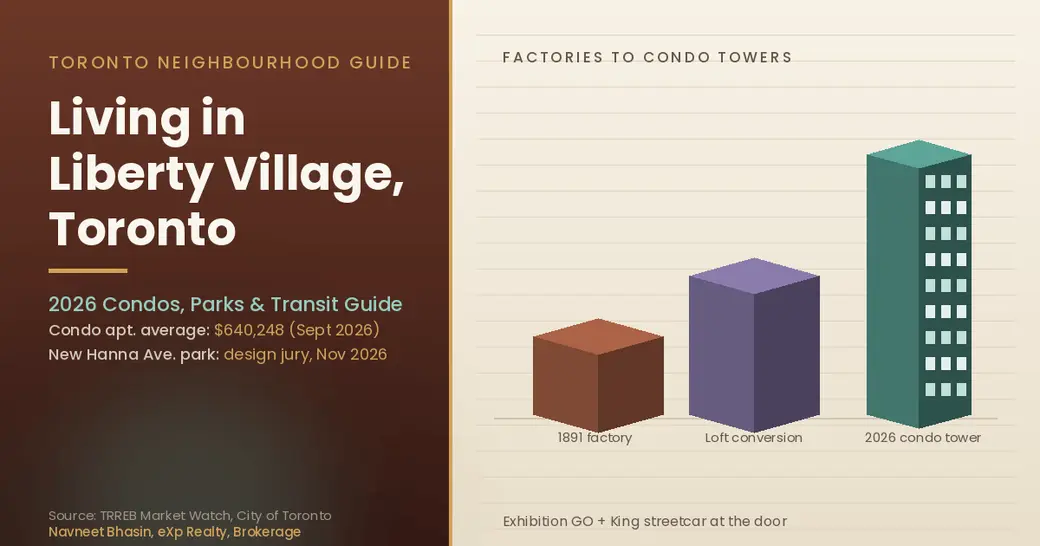
If you are weighing what living in Liberty Village Toronto actually looks like in 2026, the short answer is: a dense, walkable former factory district that is still rewriting its own rulebook, with condo prices that moved differently than the rest of the city this fall and a City Hall decision this past June that will shape the next decade of growth here. I'm Navneet Bhasin, a GTA real estate agent with eXp Realty, Brokerage, and while Brampton and Mississauga are my home turf, I get calls every month from buyers, renters and investors asking whether Liberty Village still makes sense. Here's what the city's own planning documents, TRREB's numbers and the neighbourhood's own business association actually say, without the sales pitch.
Key Takeaways
- Liberty Village is a converted industrial district bounded roughly by King Street West, Strachan Avenue, the rail corridor and Dufferin Street, built almost entirely of condo towers and renovated factory lofts, with towers reaching about 29 storeys.
- On June 25, 2026, Toronto City Council adopted the "Liberty For All" Official Plan Amendment, opening the way for more residential development — including affordable housing requirements — on the regeneration lands west of Hanna Avenue.
- A new, roughly 4,900-square-metre park at 34 Hanna Avenue is in the design-competition jury stage as of November 2026, with a winning design expected in December 2026 and a full park not opening until Fall 2030.
- City of Toronto condo apartments averaged $640,248 in September 2026, per TRREB, while the whole city's all-home-type median sat at $835,000 in October 2026 — two very different numbers for two very different housing types.
- The neighbourhood has one TDSB elementary school inside its boundaries, Niagara Street Junior Public School (JK-6), with before- and after-school care on site.
Quick Answer: Is Liberty Village a Good Place to Live in 2026?
For a renter, young professional or condo investor who wants walkable restaurants, an Exhibition GO stop, the King streetcar outside the door and a five-minute walk to the lake, living in Liberty Village Toronto still makes practical sense in 2026 — particularly if you buy or rent an existing unit rather than wait on pre-construction, given how far out the next wave of public amenities (the new park, the Liberty For All build-out) actually sits. Families who need more than one TDSB elementary option, or buyers chasing the fastest price appreciation in the GTA, should look elsewhere; I can help you weigh both.
What Is Living in Liberty Village Toronto Really Like?
Liberty Village sits in Toronto's old west end, on land that spent most of its first half-century as a penitentiary rather than a neighbourhood. The Toronto Central Prison opened here in 1873, followed by the Andrew Mercer Reformatory for Women in 1878; both closed by 1915, and the area's name comes directly from Liberty Street, the road a freed inmate would have walked out on, according to the Liberty Village Business Improvement Area's own history page. Manufacturing took over almost immediately after: John Inglis and Company built heavy machinery and later the appliances that made the Inglis name a household word, Massey-Harris (later Massey Ferguson) opened an agricultural equipment plant in 1891, and smaller operations — a carpet mill, a wine maker, a wind-engine and pump works — filled in the rest of the blocks.
That industrial base held until the late 1970s and 1980s, when rail-based shipping gave way to trucking and companies chased cheaper land in the suburbs or overseas. The Toronto Carpet plant closed in 1990 and the Inglis plant, by then owned by Whirlpool, shut in 1991. Low rents in the empty factories briefly drew artists and small studios before the loft and condo conversions that define the area today took over — the former John Inglis site is now Liberty Market, home to restaurants and retail, and the old Hinde & Dauch paper mill and Irwin Toys head office on Hanna Avenue became the Toy Factory Lofts. A handful of heritage structures survive, including the Central Prison's Roman Catholic chapel on East Liberty Street, but most of the original factory floor plates were demolished to make way for the condo towers that now house the bulk of the neighbourhood's population.
Today, Liberty Village is one of the most condo-dense pockets in Toronto, built up fast enough that the city itself has had to play catch-up on parks, schools and community space — a tension that shows up repeatedly in the planning documents below.
Liberty Village Toronto Real Estate: Condo Prices and the Fall 2026 Market
Anyone pricing out living in Liberty Village Toronto needs to look past the city's blended, all-home-types numbers, because almost everything that trades hands here is a condominium apartment, and the City of Toronto's condo-specific figures tell a more useful story. According to TRREB's September 2026 Market Watch, the City of Toronto recorded 884 condo apartment sales that month at an average price of $640,248, against 3,073 active condo apartment listings — a wide supply cushion that has kept the segment buyer-favourable most of this year.
The citywide picture moved further in October. TRREB's October 2026 Market Watch, released November 4, 2026, put City of Toronto sales across all home types at 2,184, with a dollar volume of $2,349,170,033, an average price of $1,075,627 and a median price of $835,000 — against 5,451 new listings, 9,526 active listings, a sales-to-new-listings ratio of 38.6% and 4.6 months of inventory. Toronto's average days-on-market ran 30 days to the first offer and 45 to a firm sale.
The gap between that $1,075,627 citywide average and the $640,248 condo-apartment average from the month before is the whole story of Liberty Village in one comparison: the neighbourhood's housing stock is almost entirely the lower-priced, higher-supply condo segment, not the detached and semi-detached homes pulling the city's blended average higher. TRREB President Daniel Steinfeld tied October's regional softness to a mix of a recent Canada–U.S. trade development and renewed talk of a 2027 recovery, while Chief Information Officer Jason Mercer noted that "buyers had substantial negotiating power on price over the past year" — a dynamic that has generally favoured condo buyers and investors in supply-heavy pockets like Liberty Village more than it has favoured sellers.
Table: City of Toronto housing snapshot, fall 2026
| Metric | Condo apartments (Sept 2026) | All home types (Oct 2026) |
|---|---|---|
| Sales | 884 | 2,184 |
| Average price | $640,248 | $1,075,627 |
| Median price | — (not published) | $835,000 |
| Active listings | 3,073 | 9,526 |
| Months of inventory | — (not published) | 4.6 |
Source: TRREB Market Watch, September 2026 (released October 6, 2026) and October 2026 (released November 4, 2026).
If you are pricing out a Liberty Village purchase against that landscape, or deciding whether to list a unit you already own there, schedule a free consultation and I will walk you through the actual comparable sales rather than a citywide average that mixes in Rosedale detached homes and Scarborough townhouses alike.
Parks and the Public Realm: What's Changing in Liberty Village
Liberty Village's biggest limitation has never been its restaurants or its transit — it is green space, and the City of Toronto has been working on that gap in slow, well-documented stages. In 2020, Toronto and East York Community Council asked staff to study public space and city-owned land in the area; that work became the Liberty Village Public Realm Strategy and a companion Neighbourhood Streets Plan, both adopted by Council on April 3, 2024. The Strategy calls for expanding parkland, widening sidewalks, adding traffic calming, increasing tree canopy and improving mid-block connections, while the Streets Plan recommends specific measures like new stop signs and sightline improvements.
The most visible result of that work is a new park planned for 34 Hanna Avenue, on a roughly 4,900-square-metre site at Hanna Avenue and Liberty Street that is currently a Toronto Parking Authority lot — slightly bigger than the existing Liberty Village Park. A 720-square-metre interim section, called Park in Progress, has been open to the public since June 2025. As of this run's research in November 2026, the city is in the jury-evaluation stage of an international design competition with five shortlisted teams and park concepts, including "Anakwad Park," "Liberty Yard," "Liberty Village Living Room," "Windborne Common" and "Liberty Nature Park." A winner is expected to be announced in December 2026, but the city's own timeline — subject to change — does not have the finished park opening until Fall 2030.
Running alongside the parks work is a much bigger planning decision: on June 25, 2026, Toronto City Council adopted the "Liberty For All" Official Plan Amendment, which grew out of a 2023 settlement that re-designated land west of Hanna Avenue from Employment Areas to Regeneration Areas. That amendment opens those lands to more residential use, adds an affordable-housing requirement for new development, and sets rules for how existing non-residential uses there are retained, replaced or expanded. In the same council session, Deputy Mayor Amber Morley (the ward's local deputy mayor) moved motions calling for implementation plans covering new public space, community facilities, affordable housing and traffic management — in other words, City Hall is on record saying the parks-and-schools catch-up has to happen alongside, not after, the next round of building.
What this means if you are buying or renting here: more residential development, and eventually more green space, is coming to the regeneration lands west of Hanna Avenue, but on a timeline measured in years, not months. If a listing or a pre-construction pitch leans heavily on "the new park" as a selling point, ask specifically which phase it is in — Park in Progress is real and open today; the full 34 Hanna Avenue park is not expected until 2030.
Getting Around: Transit Options for Liberty Village Residents
One of the strongest arguments for living in Liberty Village Toronto is transit, and it is an advantage that does not depend on any future expansion to work. Exhibition GO Station, on the Lakeshore West line, sits at the neighbourhood's southern edge and connects directly into Union Station downtown, with Union Pearson Express also stopping there. GO Transit has been running extra Lakeshore service around major events at the adjacent Exhibition Place grounds, including increases planned for the 2026 FIFA World Cup matches hosted in Toronto, according to Metrolinx. Within the neighbourhood itself, the King streetcar (504) runs along King Street West through the heart of Liberty Village on a dedicated transit-priority corridor that gives streetcars signal priority over car traffic, and the 509 Harbourfront line connects toward the waterfront and Exhibition Place. For residents without a car, that combination — GO rail, a king streetcar, and a short walk to most daily errands — is a genuine reason the neighbourhood has held its popularity through more than one real estate cycle.
Schools and Families Near Liberty Village
Liberty Village is overwhelmingly a renter- and young-professional-heavy market, but it does have one school inside its own boundaries: Niagara Street Junior Public School, a Toronto District School Board (TDSB) school at 222 Niagara Street serving Junior Kindergarten through Grade 6. The school describes itself as small, sits near community parks and the area's commercial and artisan strip, and offers before- and after-school care on-site through the Garrison Creek Community Day Care Centre, plus outside programs like Arts Express and chess. The school's own page does not advertise a French Immersion stream, so families who want one should check directly.
Because TDSB boundaries shift and Liberty Village sits close to several other elementary and secondary options in Toronto's west end, I always point buyers to the TDSB's own School Search Map rather than a secondhand summary — type in the exact address you are considering and confirm the current boundary before you make an offer. If schooling is the deciding factor in your decision, that is worth doing before living in Liberty Village Toronto becomes a signed agreement rather than a plan.
Who Living in Liberty Village Toronto Actually Suits
I'd rather tell you the honest trade-offs than oversell a neighbourhood that doesn't fit your life. Liberty Village tends to work well for young professionals and couples who want to walk to work downtown or along the King corridor, condo investors comfortable in a supply-heavy segment where TRREB's own numbers show real negotiating power sitting with buyers, and renters who value the GO and streetcar combination more than square footage. It tends to work less well for larger families who want more than one nearby elementary school option, buyers chasing the GTA's fastest price appreciation (Liberty Village's condo-heavy stock has not historically outpaced detached-home markets), or anyone who wants mature parkland today rather than a park that is still years from breaking ground. None of that is a verdict on the neighbourhood — it's context, and the kind of context I'd rather give you before you write an offer than after.
Frequently Asked Questions About Living in Liberty Village, Toronto
Is Liberty Village a good investment in 2026?
It depends on your goal. TRREB's September 2026 figures show City of Toronto condo apartments averaging $640,248 with a large active-listings pool, which generally favours buyers and investors over sellers right now. Liberty Village's locked-in transit access (Exhibition GO, the King streetcar) supports long-term rental demand, but the neighbourhood's growth-area status means more supply, including affordable units under the new Liberty For All plan, could keep pricing competitive for several years. Talk to an agent about specific comparable sales before assuming either direction.
When will the new park at 34 Hanna Avenue open?
The City of Toronto's current, subject-to-change timeline has the jury selecting a winning design in December 2026, detailed design running through 2027, and the full park opening in Fall 2030. A smaller, 720-square-metre interim section called Park in Progress has already been open since June 2025, so Liberty Village residents have some additional green space now, well ahead of the full build.
What is the Liberty For All plan and how does it affect residents?
Liberty For All is a City of Toronto planning study and Official Plan Amendment, adopted by Council on June 25, 2026, that re-opens the regeneration lands west of Hanna Avenue to more residential development, with a built-in affordable-housing requirement. For current residents, it signals continued construction and population growth in that part of the neighbourhood, alongside council-directed plans for new public space, community facilities and traffic management to try to keep pace.
Is Liberty Village good for families with kids?
It can work for families committed to urban, condo-based living, but the options are limited: Niagara Street Junior Public School (JK-6) is the only TDSB elementary school inside the neighbourhood's own boundaries, and the area was built primarily around young professionals rather than larger family units. Confirm your exact school boundary through the TDSB's School Search Map before buying, since boundaries can run close and change over time.
How do I get around Liberty Village without a car?
Exhibition GO Station (Lakeshore West line) sits at the neighbourhood's edge with direct service into Union Station, the 504 King streetcar runs through the neighbourhood on a dedicated transit-priority corridor, and the 509 Harbourfront line connects to the waterfront. Most daily errands, restaurants and grocery stores are within walking distance for most Liberty Village addresses.
Ready to Explore Living in Liberty Village, Toronto?
Liberty Village in 2026 is a neighbourhood in the middle of a long, carefully documented transition — more density and affordable housing are coming under the Liberty For All plan, real green space is coming but years away, and the condo market itself is giving buyers more leverage than it has in a while. Whether you're trying to time a purchase, price a sale, or simply figure out if this is the right corner of Toronto for how you actually live, I'd rather walk you through the real numbers than let a listing description do it for you. Thinking about buying, selling or renting in Liberty Village or anywhere else in the GTA? Schedule a free consultation with me, Navneet Bhasin, and let's look at your specific situation.
Navneet Bhasin is a real estate agent with eXp Realty, Brokerage, serving Brampton, Mississauga, Toronto and the Greater Toronto Area. Reach him at (905) 872-2682, nav@teamnav.ca, or teamnav.ca.
This article is for general information only and is not financial, mortgage, legal or tax advice. Confirm current prices, school boundaries and planning timelines directly with the relevant authority before making a decision.
Categories
Recent Posts