Luxury Homes on the Bridle Path in Toronto: 2026 Guide
If you're looking at homes on the Bridle Path in Toronto, you're shopping in one of the most exclusive residential streets in Canada: large estate lots, custom-built mansions, and a level of privacy you won't find almost anywhere else in the GTA. I'm Navneet Bhasin, a real estate agent with eXp Realty, Brokerage, and while most of my work is in Brampton and Mississauga, I get calls every year from GTA buyers and investors curious about this North York enclave. This guide covers what actually sets the Bridle Path apart, what it costs to buy and carry a home there in 2026, and the questions I hear most often.
Key Takeaways
- The Bridle Path sits inside the City of Toronto's Bridle Path-Sunnybrook-York Mills neighbourhood, where the 2016 Census reported a median household income of $215,798, more than three times the citywide figure of $65,829.
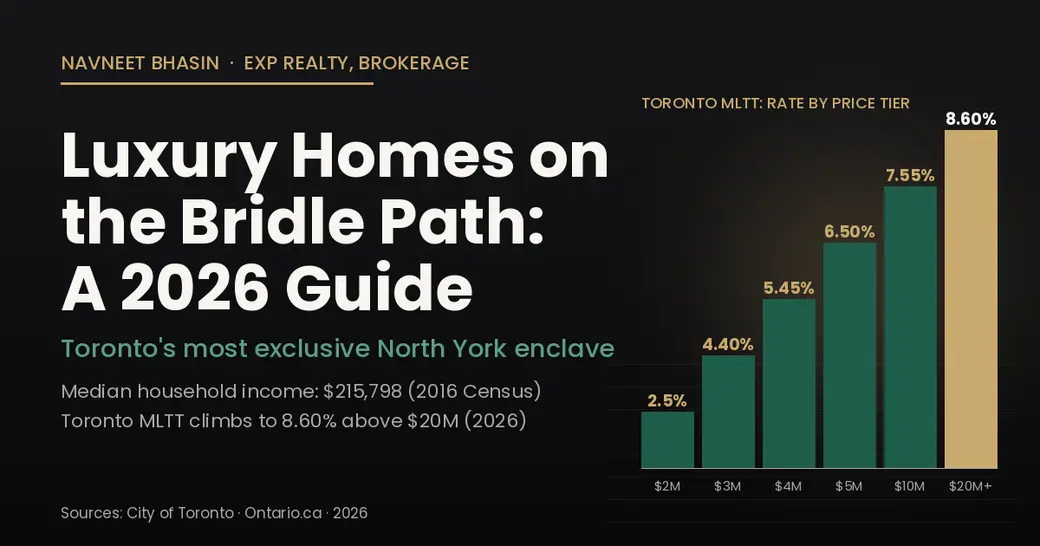
- A purchase above $3 million on the Bridle Path triggers Toronto's steepest Municipal Land Transfer Tax brackets, on top of Ontario's own land transfer tax, both due in full on closing day.
- TRREB does not publish street-level or neighbourhood-level sale prices for the Bridle Path specifically, so any number you see quoted for "the Bridle Path" should be treated as an estimate, not a fact.
- Sunnybrook Park, with its trails, off-leash area and equestrian facility, sits directly against the neighbourhood and is one of its biggest lifestyle draws.
Quick Answer: What Do Luxury Homes on the Bridle Path Cost in 2026?
There is no official published average for luxury homes on the Bridle Path specifically. The City of Toronto's own neighbourhood data and TRREB's market statistics are reported at a wider geography than this one street, so the honest answer is that pricing here has to be assessed property by property, almost always well above the City of Toronto's own detached-home average. Treat any "average Bridle Path price" you see elsewhere with real skepticism.
Luxury Homes on the Bridle Path: What Makes This Toronto Address Different
The Bridle Path runs through what the City of Toronto classifies as the Bridle Path-Sunnybrook-York Mills neighbourhood, tucked between Bayview Avenue and Leslie Street, south of York Mills Road, inside the former City of North York. The lots here are large by Toronto standards, the setbacks are generous, and the street itself has no sidewalks in long stretches, which is part of its old-money, low-density character. Sunnybrook Park and the Don River ravine system form the neighbourhood's southern edge, which is a big part of why lots here feel more like country estates than city properties.
Unlike a condo corridor or a typical freehold subdivision, there's no single builder or era defining the housing stock. Homes range from older mid-century estates to fully rebuilt contemporary mansions, often custom-designed and built to the buyer's own specifications rather than bought off a standard plan.
The Income and Housing Profile Behind the Reputation
The City of Toronto's most recent published neighbourhood profile for this area uses 2016 Census data, so treat these figures as a snapshot rather than a current reading, but they explain a lot about the area's reputation. The neighbourhood's median household income was reported at $215,798, against a citywide median of $65,829. Median family income came in at $266,931, versus $82,859 city-wide. About 70% of dwellings in the neighbourhood were single-detached houses, average household size was 2.83 people, and of the roughly 3,245 occupied private dwellings, about 2,940 were owner households against only 295 renter households. This is a neighbourhood built almost entirely around ownership, not rental turnover, which supports long-term price stability more than a rental-heavy market would.
Land Transfer Tax on a Bridle Path Purchase
I am a real estate agent, not a lawyer or a tax professional, so treat this as general information rather than advice for your specific purchase. On any Ontario property, you pay the provincial land transfer tax, calculated on a sliding scale: 0.5% up to $55,000, 1.0% up to $250,000, 1.5% up to $400,000, 2.0% up to $2,000,000, and 2.5% on the portion above $2,000,000 for land containing one or two single-family residences, per Ontario's own published formula.
Because the property sits inside the City of Toronto, you also owe the Municipal Land Transfer Tax (MLTT), which mirrors the provincial brackets up to $2 million and then climbs its own staircase above that. As of the rates City Council approved for April 1, 2026, the MLTT on a one- or two-family residence runs 2.5% from $2,000,000.01 to $3,000,000, 4.40% from $3,000,000 to $4,000,000, 5.45% from $4,000,000 to $5,000,000, 6.50% from $5,000,000 to $10,000,000, 7.55% from $10,000,000 to $20,000,000, and 8.60% above $20,000,000, according to the City of Toronto's own MLTT rates and fees page. On a $6 million purchase, for example, you would be paying both the provincial tax and this municipal tax, stacked on top of each other, and both are due in full on closing, not financed into your mortgage. Budget for it as cash you need on hand, not as a line item you can negotiate away later.
| Value of Consideration | Toronto MLTT Rate (one- or two-family home) |
|---|---|
| $2,000,000.01 to $3,000,000 | 2.50% |
| $3,000,000 to $4,000,000 | 4.40% |
| $4,000,000 to $5,000,000 | 5.45% |
| $5,000,000 to $10,000,000 | 6.50% |
| $10,000,000 to $20,000,000 | 7.55% |
| Above $20,000,000 | 8.60% |
This MLTT table is in addition to Ontario's own provincial land transfer tax, which applies on top of it, not instead of it.
Property Taxes on a Bridle Path Estate
Toronto's 2026 total residential property tax rate, combining the city rate, the City Building Fund levy and the education portion, works out to 0.767311% of your property's assessed value. Ontario assessments are still based on a January 1, 2016 valuation date, since the province has twice postponed a general reassessment, so a large or recently rebuilt Bridle Path home can carry an assessed value that looks nothing like its market price. Ask the seller for the actual, current tax bill rather than applying the rate to the sale price yourself. A major renovation or new build can also trigger a reassessment, so budget for your tax bill to move once MPAC catches up with the finished property.
Sunnybrook Park, Schools and What's Nearby
Sunnybrook Park, directly along the neighbourhood's southern flank, is one of the biggest lifestyle draws of living here. The City of Toronto maintains a dedicated off-leash dog area inside the park, and the park has long hosted equestrian facilities, including a leased horse-boarding operation, reflecting the area's bridle-trail history. Trails here connect into the wider Don River Valley ravine and trail network, giving Bridle Path residents direct access to green space most Toronto neighbourhoods have to drive to.
For schools, this area falls within the Toronto District School Board's catchment, but boundaries can and do shift, and TDSB does not publish a single page specific to the Bridle Path. Use the TDSB's own Find Your School tool, searchable by address, to confirm the current public elementary and secondary school for a specific property rather than relying on a general neighbourhood description, mine included.
Should You Buy on the Bridle Path in 2026?
If you're buying here as a primary residence, the case is straightforward: privacy, lot size, and proximity to Sunnybrook Park and the Don Valley Parkway corridor are hard to replace anywhere else in the GTA. If you're looking at luxury homes on the Bridle Path as an investment or a redevelopment opportunity, treat them the way you would any other high-value, low-liquidity asset: there are relatively few comparable sales in any given year, financing is more specialized than a typical residential mortgage, and resale timelines can run longer than in a high-volume market like Brampton or Mississauga condos. I'd rather tell you that plainly than have you find it out after you've written an offer.
Whatever price point you're working at, the fundamentals don't change: get a real, current tax bill, confirm the school boundary through the board directly, and budget both land transfer taxes as cash, not financing. Thinking about buying or selling a luxury property in Toronto, or anywhere in the GTA? Schedule a free consultation with me and we'll talk through the numbers for your specific situation.
Frequently Asked Questions About the Bridle Path
What is the average price of a home on the Bridle Path?
There is no official published average specific to the Bridle Path. TRREB and the City of Toronto report figures at a wider neighbourhood or citywide level, not street by street, so treat any specific number you see quoted elsewhere as an estimate rather than verified data.
Is the Bridle Path part of North York?
Yes. The Bridle Path sits within the former City of North York, inside the City of Toronto's Bridle Path-Sunnybrook-York Mills neighbourhood, bounded roughly by Bayview Avenue, Leslie Street and York Mills Road.
How much land transfer tax would I pay buying on the Bridle Path?
You would pay both Ontario's land transfer tax and Toronto's Municipal Land Transfer Tax, calculated separately and added together. Above $3 million, the City of Toronto's MLTT rate on a one- or two-family home rises to 4.40%, then climbs further at $4 million, $5 million, $10 million and $20 million thresholds.
What school boundaries serve the Bridle Path?
The area falls within the Toronto District School Board, but exact boundaries shift over time. Use TDSB's Find Your School tool with the specific property address rather than relying on a general neighbourhood guide.
What is Sunnybrook Park known for?
Sunnybrook Park, bordering the neighbourhood, is known for its trail network connecting into the Don River Valley, a City-maintained off-leash dog area, and a long history of equestrian use, including horse-boarding facilities.
Categories
Recent Posts