
Living in the Junction Toronto: A 2026 Lifestyle Guide
Living in the Junction Toronto means low-rise Victorian and Edwardian storefronts along a curving Main Street, a City heritage study that could reshape how the area grows, and a long-delayed rail trail finally inching toward construction. Tucked into Toronto's west end around Dundas Street West and Keele Street, the Junction grew up where three railways crossed in the late 1800s, spent nearly a century as one of the city's only "dry" neighbourhoods, and has spent the last twenty-five years filling back in with cafés, breweries and young families. I'm Navneet Bhasin, a real estate agent with eXp Realty, Brokerage, and I've helped GTA buyers weigh character neighbourhoods like this one against newer builds further out. Here's what actually matters if you're considering it.
Key Takeaways
- The Junction grew up around the 1870s-1890s meeting point of three railway lines, and the name stuck even after the area was annexed into the City of Toronto in 1909.
- A City of Toronto Heritage Conservation District Study covering part of Dundas Street West is in its final stage, with recommendations due to the Toronto Preservation Board in Q1 2027.
- The West Toronto Railpath's southward extension has been in planning for close to twenty years and was still not under construction as of early 2026, despite a City-targeted 2026 start.
- Toronto's October 2026 citywide housing figures (TRREB) show an all-home-types average of $1,075,627, but the Junction's low-rise, mostly freehold housing stock tracks closer to the city's detached and semi-detached numbers than to its condo-heavy blended average.
What Is It Like Living in the Junction, Toronto?
Living in the Junction, Toronto is largely about scale: narrow, two- and three-storey brick storefronts from the 1900s and 1910s line a curving stretch of Dundas Street West, with century-old semis and detached homes on the side streets behind them. The neighbourhood sits in Ward 4 (Parkdale-High Park), bordered roughly by Keele Street, Dupont Street, Runnymede Road and the rail corridor, with High Park just to the south. It reads as a walkable, independent-business commercial strip wrapped in an established residential area, which is why it tends to attract buyers who want character and community over new-build convenience.
A Brief History of the Junction's Railway Roots
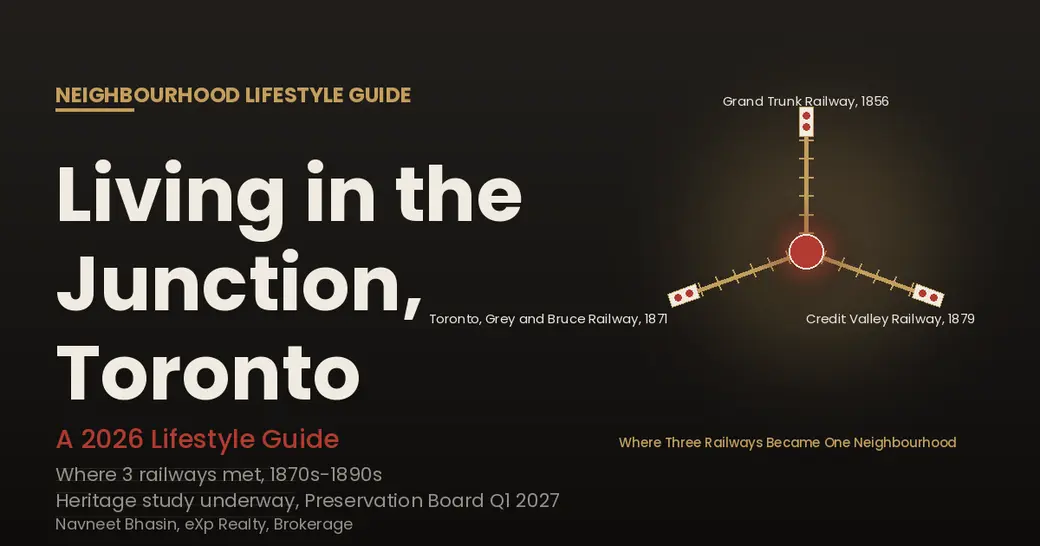
The Junction gets its name honestly. The Grand Trunk Railway (1856), the Toronto, Grey and Bruce Railway (1871) and the Credit Valley Railway (1879) all converged at this spot, and the junction gave the area its name, according to the City of Toronto's own heritage research for the area. The surrounding village was established around 1884 and incorporated in 1887, grew into a town, and the Town of West Toronto briefly existed as its own city before the Town of West Toronto was annexed by the City of Toronto in 1909 — Dundas Street West served as its commercial and civic centre both before and after that annexation.
The area's best-known quirk came in 1904, when a local vote banned the sale of alcohol. According to the City's own heritage study, that ban held until 2000; a local history source puts the end date at 1996 instead, and since the two don't agree, I'd treat either as approximately right rather than exact. Either way, the Junction was effectively dry for most of a century, which is part of why its current wave of breweries, bars and cafés along Dundas Street West still gets talked about as something genuinely new for the neighbourhood.
Heritage Character and the Junction's Ongoing HCD Study
If you're buying here, it's worth knowing that the City of Toronto is partway through a West Toronto Junction Heritage Conservation District (HCD) Study, covering a stretch of Dundas Street West from around Annette Street to near Clendenan Avenue, plus nearby frontages on Keele Street. The study has identified roughly 292 properties in the proposed study area, of which about 154 are considered "contributing" to the area's heritage character — almost half were built between 1900 and 1919, and about 70% date from before 1920.
This is a study, not a designation: it's meant to determine whether an HCD Plan is the right tool for the area, and the Toronto Preservation Board hasn't made that call yet. The City held a second public open house on June 17, 2026, and the heritage consultant's final recommendations are expected to reach the Preservation Board sometime in the first quarter of 2027. For a buyer, that means exterior renovation and infill rules on and near Dundas Street West could tighten in the next year or two — worth asking about before you commit to a renovation budget on a property inside the study boundary.
Parks, Trails and the Railpath Through the Junction
The West Toronto Railpath runs along the old rail corridor from around Cariboo Avenue, just north of Dupont Street, down to the Dundas Street West overpass, and it's one of the better car-free cycling and walking connections in this part of the city. The City has been trying to extend it south toward King Street and Abell Street for close to two decades, and as of a January 2026 report, that extension still hadn't broken ground, even though the City's own target was a 2026 construction start — delayed in part by Metrolinx's ongoing track-widening work near Bloor GO Station, which closed a core section of the existing path. The City's own West Toronto Railpath project page, updated October 1, 2026, still describes that nearby segment as closed, with reopening anticipated in fall 2026.
Closer to home, the HCD study area itself includes two City-owned green spaces, Dundas-Watkinson Parkette and Malta Park, and the neighbourhood sits within an easy walk of High Park to the south — one of the largest and most-used parks in the city.
Shops, Cafés and Local Life Along Dundas Street West
What draws a lot of people to the Junction is simply walking Dundas Street West itself: narrow Victorian and Edwardian storefronts, most two to three storeys, house an independent mix of cafés, breweries, vintage and antique shops, and restaurants rather than chain retail. The streetwall is continuous and low-rise by design — the City's own heritage research flags that scale, along with brick construction and narrow storefronts with wide sign bands, as one of the area's defining physical traits. It's a neighbourhood built for walking rather than driving between destinations, and that main-street feel is a big part of why longtime residents and newer arrivals alike tend to describe it as having real community character.
Getting Around From the Junction
The Junction is well served by TTC and regional transit. Keele and Dundas West stations on Line 2 (Bloor-Danforth) sit just south of the neighbourhood's core, and Dundas West also connects to the UP Express and GO Transit's Kitchener line, giving a direct run to Union Station or Toronto Pearson. Surface routes run along Dundas Street West and connecting streets, and the West Toronto Railpath adds a dedicated cycling connection north toward Dupont Street and, eventually, south toward downtown once its extension is built.
Housing Prices in the Junction and the Wider Toronto Market
The Toronto Regional Real Estate Board (TRREB) doesn't publish a Junction-specific sales figure, so the closest verified numbers are City of Toronto-wide, and the citywide blended average leans heavily on downtown condo volume rather than the low-rise freehold stock that dominates the Junction. Compare the segments and the gap is clear:
| Toronto Segment (TRREB) | Average Price | Period |
|---|---|---|
| All home types | $1,075,627 | October 2026 |
| Detached | $1,562,966 | September 2026 |
| Semi-detached | $1,207,884 | September 2026 |
| Condo apartment | $640,248 | September 2026 |
The Junction's housing stock skews toward the detached and semi-detached rows, not the blended citywide figure or the condo number — a reminder that the city average on its own tells you very little about what a semi on a Junction side street actually costs.
On carrying costs, Toronto's property tax rate remains the lowest among the GTA municipalities I track, at roughly $767.31 per $100,000 of MPAC-assessed value, though MPAC's assessments are still based on 2016 values, so the rate alone doesn't capture everything about what you'd actually pay. Buyers should also budget for Ontario's land transfer tax plus the additional municipal land transfer tax that applies anywhere inside the City of Toronto, including the Junction.
Schools Near the Junction
The Junction falls within the Toronto District School Board and the Toronto Catholic District School Board, with elementary schools including Annette Street Junior Public School and Keele Street Public School serving parts of the area. Boundaries shift from time to time — TDSB has run boundary reviews involving Keele Street Public School in recent years — so rather than quote a boundary that may have moved, I'd always point a buyer to TDSB's own school locator tool to confirm which school serves a specific address before making an offer.
Is Living in the Junction, Toronto, Right for You?
The Junction tends to suit buyers who want an established, walkable neighbourhood with genuine local character over a newer build further from downtown — people drawn to century homes, a short commute via Line 2 or the UP Express, and a main street they'd actually choose to spend a Saturday on. It's a tougher fit if you want new-construction finishes, a larger lot, or if you're priced out of freehold and are comparing against the city's generally cheaper condo-apartment segment instead. Either way, the ongoing heritage study and the stalled Railpath extension are both genuinely live factors worth understanding before you buy here, not just interesting trivia.
Frequently Asked Questions About Living in the Junction, Toronto
Is the Junction a good neighbourhood to live in?
It depends on what you're after. The Junction suits buyers who want walkable, independent-business street life and century-home character; it's a weaker fit if new-construction finishes or larger modern lots matter more to you than location and streetscape.
Why is it called "the Junction"?
Three railway lines — the Grand Trunk (1856), the Toronto, Grey and Bruce (1871) and the Credit Valley Railway (1879) — converged at this spot in the late 1800s, and the area took its name from that rail junction.
Is the Junction still a "dry" neighbourhood?
No. A 1904 local vote banned alcohol sales for most of a century; the City's own heritage research dates the end of that ban to 2000 (one other local source says 1996). Either way, the current concentration of breweries, bars and cafés is a relatively recent development.
What's happening with the West Toronto Railpath extension?
The City has targeted a 2026 construction start for extending the trail south toward King and Abell Streets, but as of early 2026 that start had not yet happened, with delays tied partly to Metrolinx's nearby track-widening work. Check the City of Toronto's West Toronto Railpath page for the current status before assuming a completion date.
How much does a home cost in the Junction?
TRREB doesn't break out a Junction-specific number. The closest verified figures are City of Toronto-wide, and they vary a lot by housing type — see the table above — so ask which segment actually matches the kind of home you're comparing before trusting any single average.
Thinking About a Move to the Junction?
The Junction rewards buyers who do their homework on a heritage-conscious, low-rise neighbourhood in transition — between the ongoing HCD study, the long-promised Railpath extension and a housing stock that doesn't track the city's blended average, there's more to get right here than in a typical new-build search. If you're weighing a purchase or sale in the Junction or anywhere else in the GTA, schedule a free consultation with me and we'll go through exactly what a specific street or listing means for your situation.
Navneet Bhasin is a real estate agent with eXp Realty, Brokerage, serving Brampton, Mississauga, Toronto and the Greater Toronto Area. Reach him at (905) 872-2682, nav@teamnav.ca, or teamnav.ca.
Categories
Recent Posts