Buying a Condo in CityPlace Toronto: Complete 2026 Guide
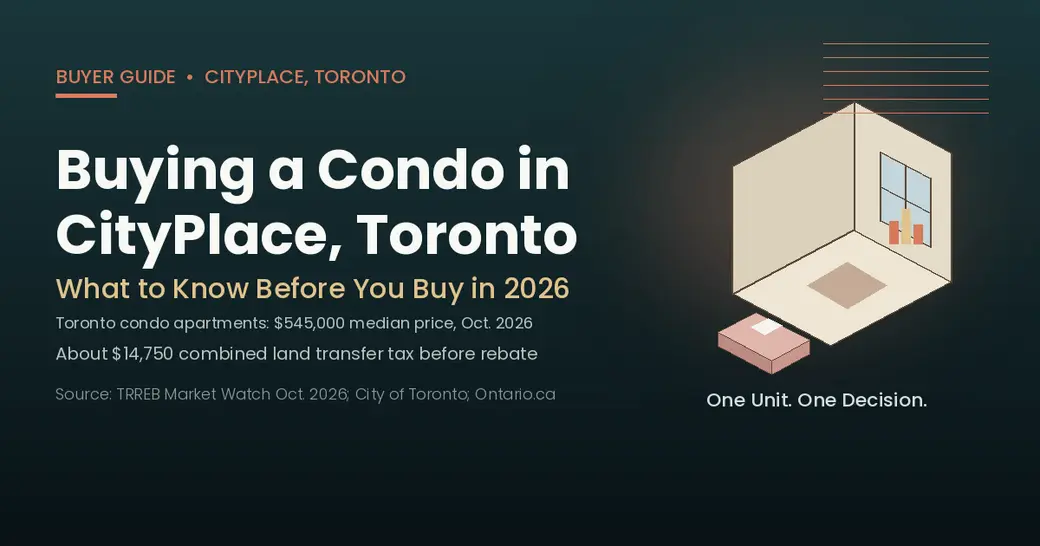
Buying a condo in CityPlace Toronto means buying into one of the largest single condo communities ever built in Canada, a cluster of towers on former rail lands bounded roughly by Spadina Avenue, Bathurst Street, Front Street and the Gardiner Expressway. I'm Navneet Bhasin, a real estate agent with eXp Realty, Brokerage, and I help buyers across the GTA weigh exactly this kind of downtown Toronto condo purchase against the suburban alternatives. CityPlace is walkable, transit-rich and almost entirely high-rise, which makes it a very different kind of purchase than a freehold home in Brampton or Mississauga, with its own cost structure, its own risks, and its own reasons to love it.
Key Takeaways
- City of Toronto condo apartments averaged $659,214 and had a median price of $545,000 in October 2026, per the Toronto Regional Real Estate Board (TRREB) — the closest verified proxy for CityPlace, since TRREB does not publish a CityPlace-specific figure.
- Every resale condo purchase should include a status certificate review by a real estate lawyer, covering the building's reserve fund, budget and any pending special assessments.
- Toronto condo buyers pay land transfer tax twice — once to Ontario, once to the City of Toronto — though first-time buyers can recover up to $8,475 combined through both rebate programs.
- Jean Lumb Public School, Canoe Landing Park and a TTC streetcar network give the neighbourhood genuine day-to-day livability, not just a skyline view.
Quick Answer: Is CityPlace a Good Place to Buy a Condo in 2026?
CityPlace suits a buyer who wants walkable downtown living, a short commute to the financial core, and a resale market deep enough to offer real choice across price points and building ages. It suits that buyer less well if they want outdoor space, low-rise construction, or a quiet pace — CityPlace is almost entirely high-rise, built out over roughly 25 years, and the building's age, reserve fund and monthly fees matter more to the final cost than the view does.
What Is CityPlace, and Why Do So Many Toronto Buyers Start Here?
CityPlace sits on land Concord Adex purchased from the Canada Lands Company in 1997, built out from the former railway lands just west of Rogers Centre and the CN Tower. Construction began in 2000, and the project's final phase, Canada House, broke ground roughly 18 years later, with towers reaching 59 and 69 storeys, the tallest in the community. A dozen buildings now occupy roughly ten city blocks, and the neighbourhood's own population mix has shifted over time — the University of Toronto's Matti Siemiatycki has described it moving from mostly young singles toward a more mixed population that now includes families and seniors, a sign the community has matured well past its original pitch.
In April 2022, the City of Toronto formally recognized this by splitting the old "Waterfront Communities-The Island" planning area into three new social-planning neighbourhoods, one of them named Harbourfront-CityPlace (Neighbourhood 165). That gives CityPlace its own civic identity distinct from Liberty Village or the Fort York waterfront, even though all three sit within the same City Council ward.
How Much Does Buying a Condo in CityPlace Toronto Cost in 2026?
TRREB does not publish a CityPlace-specific sales figure, so the closest verified benchmark is the City of Toronto's condo-apartment segment for October 2026 — and because CityPlace is almost entirely high-rise condo stock, it is a reasonable proxy.
| Metric (October 2026) | All City of Toronto Home Types | Condo Apartments Only |
|---|---|---|
| Sales | 2,184 | 949 |
| Average price | $1,075,627 | $659,214 |
| Median price | $835,000 | $545,000 |
| Active listings | 9,526 | 5,251 |
| Sale-to-list price ratio | 98% | 97% |
| Avg. days on market | 30 | 36 |
Source: Toronto Regional Real Estate Board, Market Watch, October 2026.
Condo apartments across the city sold for roughly $420,000 less on average than the all-home-types figure, which blends in detached and semi-detached sales. Within CityPlace itself, expect a wide spread by building age and size — the earliest 2000s-era towers near Spadina and Fort York Boulevard typically price lower per square foot than the newer Canada House towers toward Bathurst and Front.
Who Lives in CityPlace?
CityPlace falls within City Council Ward 10 (Spadina-Fort York). The City of Toronto's 2021 Census profile for the ward shows a population of 135,400, up 18.4% from 114,315 in 2016 — one of the fastest-growing wards in the city. The ward's median age is 32.8, well below the citywide 39.6, and 88.0% of dwellings are apartments in buildings of five storeys or more. Renters made up 58.1% of households, and of those renter households, 36,650 units were specifically condominiums rented out by their owners — a useful data point for anyone considering CityPlace as an investment rather than a primary residence. Average household size was 1.68, among the smallest in the city, consistent with a neighbourhood built around studio and one-bedroom units.
Schools, Parks and Daily Life in CityPlace
CityPlace is more livable day to day than its skyline suggests, mostly because of one deliberately built civic anchor: the Canoe Landing campus at Lake Shore Boulevard and Brunel Court. Jean Lumb Public School, a Toronto District School Board (TDSB) school serving Junior Kindergarten through Grade 8, opened there in fall 2019 as part of a shared facility with 16 classrooms, dedicated arts, science and music rooms, a green roof and solar panels, built to serve about 550 students. The same campus houses the Canoe Landing Community Recreation Centre next door. Families considering Toronto Catholic District School Board (TCDSB) options should confirm the specific boundary directly with the board, since no CityPlace-specific TCDSB boundary document was found for this guide.
Canoe Landing Park itself, anchored by its well-known red canoe sculpture, gives the neighbourhood a genuine outdoor gathering point: a splash pad, playground, multi-purpose and soccer fields, and an off-leash dog area the City has been actively expanding. A short walk south and under the Gardiner Expressway, The Bentway turns leftover highway undercroft space into a public skate trail each winter, one of the more distinctive cold-weather amenities anywhere in the city.
Getting Around: CityPlace's Transit and Walkability
CityPlace's single biggest practical advantage is its proximity to Union Station, Toronto's primary transit hub for the TTC subway, GO Transit regional rail and the UP Express airport link, generally reachable on foot from most CityPlace towers. TTC streetcars run along the neighbourhood's edges, connecting to the Entertainment District, King West and the waterfront without a car. For a buyer coming from a drive-everywhere GTA suburb, that walkability is often the single biggest lifestyle change CityPlace represents, and it is worth testing in person, in winter as well as summer, before writing an offer.
What to Check Before You Buy: Status Certificates and Reserve Funds
Every resale condo purchase in Ontario, CityPlace included, should go through a status certificate review before the firm deadline on your offer. Under the Condominium Act, the condo corporation must provide this document within 10 days of a request, for a fee capped at $100 including tax. It should include the current declaration, by-laws and rules, the current budget, the most recent audited financial statements, the most recent reserve fund study and the state of that fund, the unit's common expenses and whether it is in arrears, any planned common-expense increases or special assessments, and a certificate of insurance, according to the Condominium Authority of Ontario (CAO).
That last item, special assessments, is the one buyers most often skip over. A Toronto condo corporation in North York made headlines in 2026 when its board told roughly 100 unit owners they faced a special assessment of about $70,000 each, or a $7-million corporate loan instead, after engineers found water penetration posing a "serious structural risk" to the parking garage, CTV News reported. CityPlace's own towers range from roughly 25 years old to brand new, and reserve fund health varies tower by tower — it is not something you can judge from the lobby. Have your lawyer read the status certificate and the reserve fund study before you waive any financing or inspection conditions, not after.
Land Transfer Tax on a CityPlace Condo: What Buyers Actually Pay
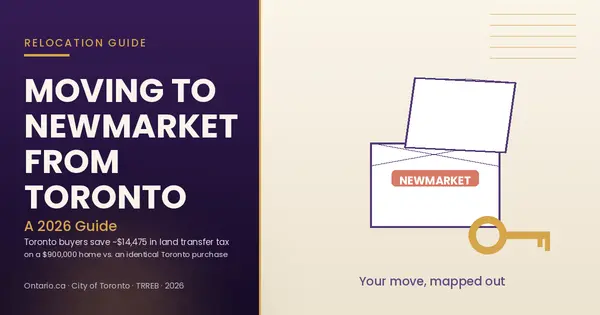
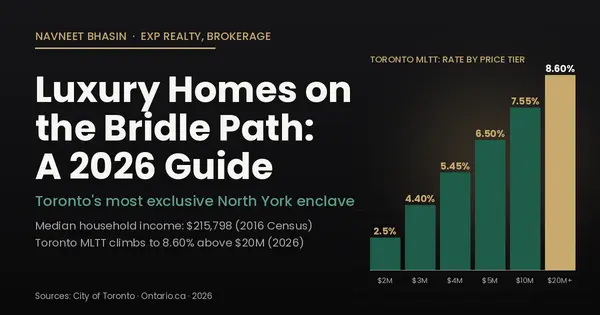
Toronto is the only municipality in Ontario that charges its own land transfer tax on top of the provincial one, so a CityPlace purchase costs more in closing-day tax than the identical purchase would in Brampton, Mississauga or almost anywhere else in the GTA. For a purchase between $400,000 and $2,000,000, Ontario's land transfer tax formula is $4,475 plus 2% of the amount over $400,000; Toronto's Municipal Land Transfer Tax (MLTT) mirrors the provincial brackets up to $2,000,000, so the City's share comes out to the same dollar figure.
| On a $545,000 condo | Ontario LTT | Toronto MLTT | Combined |
|---|---|---|---|
| Before any rebate | $7,375 | $7,375 | $14,750 |
| First-time buyer rebate | -$4,000 | -$4,475 | -$8,475 |
| Net payable | $3,375 | $2,900 | $6,275 |
A first-time buyer, as defined by both programs, must be at least 18, must never have owned a home anywhere in the world (including with a spouse), and must move in within nine months of closing. Ontario's rebate tops out at $4,000; Toronto's own MLTT rebate tops out at $4,475; applications for both are due within 18 months of closing. Without that rebate, a repeat buyer at the same $545,000 price pays the full $14,750 — a cost that simply does not exist on the same purchase in Brampton or Mississauga, where there is no municipal land transfer tax at all.
Is Buying a Condo in CityPlace Toronto Right for You?
CityPlace rewards a buyer who genuinely wants to live car-free or close to it, who values walkability and a short commute over square footage, and who is comfortable budgeting condo fees and a careful status certificate review into the true cost of ownership. It also works as an investment property, given how large a share of the local housing stock is already tenanted — but the same reserve-fund diligence applies whether you plan to live there or rent it out. If what you actually want is a driveway, a backyard and more square footage for the dollar, a suburban GTA market is almost always the better fit, and that comparison is worth making honestly before you fall for the skyline view.
Frequently Asked Questions About Buying a Condo in CityPlace, Toronto
Is CityPlace a good investment in 2026?
It depends on your goals. CityPlace has a deep rental pool (Ward 10's census shows well over 36,000 renter-occupied condo units) and strong transit access, both of which support steady tenant demand, but condo-apartment prices and days-on-market have softened citywide through 2026, so treat it as a longer-term hold rather than a quick flip.
What is a status certificate and do I need one?
Yes, on every resale condo purchase. It is a document the condo corporation must provide within 10 days of a request, for a fee capped at $100, covering the building's finances, reserve fund, bylaws and any pending special assessments. Have a real estate lawyer review it before your conditions come off.
Are CityPlace condo fees high?
They vary significantly by building age, size and included utilities, and no single figure applies across a community this large. Ask your agent for the specific building's fee history and whether heat, hydro or water are included, and compare that against the reserve fund study rather than judging the fee in isolation.
Which schools serve CityPlace?
Jean Lumb Public School (TDSB), at Lake Shore Boulevard and Brunel Court, serves Junior Kindergarten through Grade 8 and opened in 2019 as part of the Canoe Landing community campus. Families needing a Toronto Catholic District School Board option should confirm the exact boundary directly with TCDSB, as it was not available in a text-based format for this guide.
How much is land transfer tax on a $545,000 condo in Toronto?
Combined Ontario and Toronto land transfer tax on a $545,000 purchase is about $14,750 before any rebate. A qualifying first-time buyer can recover up to $8,475 of that between the two programs, bringing the net cost down to roughly $6,275.
Ready to Find Your Fit in CityPlace or Elsewhere in the GTA?
Buying a condo in CityPlace Toronto is as much a lifestyle decision as a financial one — you are trading square footage and a driveway for walkability, transit and a downtown address, and the building's reserve fund matters as much as its view. Whether CityPlace, Liberty Village or a freehold home in Brampton or Mississauga actually fits your budget and your life is a conversation worth having before you start touring units.
I'm Navneet Bhasin, a real estate agent with eXp Realty, Brokerage, and I help buyers compare condo and freehold options across downtown Toronto and the wider GTA every month. Thinking about buying a condo in CityPlace? Schedule a free consultation with me, call (905) 872-2682, or email nav@teamnav.ca, and let's figure out whether this is the right address for you.
This post is for general information only and is not financial, mortgage, legal or tax advice. Land transfer tax figures are calculated from published 2026 provincial and municipal rate schedules; confirm current rates, rebate eligibility and your own closing costs with a lawyer or the relevant government office before relying on them.
Categories
Recent Posts