Living in Aurora, Ontario: 2026 Guide
Living in Aurora Ontario means a town of about 62,000 people at the north end of York Region, built mostly of detached houses, where the typical home sold for $1,170,302 in October 2026. I'm Navneet Bhasin, a real estate agent with eXp Realty, Brokerage, and I work across the Greater Toronto Area. Aurora comes up constantly with clients who want the GO train, a main street they can walk to, and a step up in lot size from Vaughan or Markham — without moving all the way out to Newmarket or beyond. Here is what the Town's own documents and the most recent published market numbers actually say, and what I'd want a buyer or seller to know before deciding.
Quick answer: what is living in Aurora Ontario like in 2026?
Living in Aurora Ontario puts you in a town of 62,057 people (2021 Census), up from 55,445 in 2016 — growth of about 11.9 per cent in five years, according to the Town of Aurora's own community profile. It sits on the Barrie GO corridor, about 45 minutes by train from Union Station, bordered by Newmarket to the north, Richmond Hill to the south, King Township to the west and Whitchurch-Stouffville to the east. Housing is still described by the Town as "mostly single detached," though a wider mix is being added along Yonge Street. In October 2026, Aurora homes sold in an average of 39 days at 98 per cent of asking, at an average price of $1,170,302 and a median of $1,131,500 — both above the York Region and GTA-wide averages.
Key Takeaways
- Aurora's average sale price was $1,170,302 in October 2026, above the York Region average of $1,142,789 and well above the GTA-wide average of $1,024,108 (TRREB Market Watch, October 2026).
- A detached home in Aurora averaged $1,395,203 on just 32 sales — a thin market, and one where a single closing can move the average.
- Population grew from 55,445 to 62,057 between the 2016 and 2021 Census counts, an increase of about 11.9 per cent (Town of Aurora Community Profile).
- The Town maintains roughly 62 kilometres of trails, anchored by the Tim Jones (Nokiidaa) Trail running from Vandorf Woodlot through Sheppard's Bush to the Newmarket border.
- Aurora's 2026 budget set a 2.2 per cent property tax increase — about $56.94 a year on a home assessed at $800,000 — funding a $67.8-million slice of a $372-million ten-year capital plan.
Aurora's neighbourhoods: from Aurora Village to Bayview Wellington
Aurora is a compact town, but it breaks into a handful of distinct areas that buyers in Brampton or Mississauga rarely need to think about, because Aurora's lot sizes and street patterns shift noticeably from one to the next.
Aurora Village, the historic core along Yonge Street, is the oldest part of town — what the Town's own Aurora Promenade planning documents call the Downtown and Old Town areas. It's the walkable part: shops, the library, Town Hall and the Aurora Cultural Centre are all within a few blocks of each other, and the housing nearby is a mix of century homes and smaller post-war lots.
Aurora Highlands, west of Yonge Street, is a mature suburban area built mostly through the 1980s and 1990s, with larger detached lots and mature trees. It's a short drive or bike ride to Sheppard's Bush and the Tim Jones Trail.
Bayview Wellington, in the town's east end near Bayview Avenue and Wellington Street, is newer, built out through the 2000s, with a mix of detached homes and townhouses closer to Highway 404. Properties here tend to run a bit larger and newer than the Aurora Village core, which the October 2026 numbers below help explain.
The Town's Aurora Promenade Urban Design Strategy, which governs the Yonge Street corridor from the north end of town to the south, is the other piece of the geography worth knowing. It identifies the Aurora GO Station area as a focus for higher-density, mixed-use development going forward, which is the clearest signal of where future condo and townhouse supply is likely to land, even though the Town's own document gives no specific height or unit targets — it speaks only in qualitative terms about "appropriate transition in scale."
What does it cost to buy a home in Aurora in 2026?
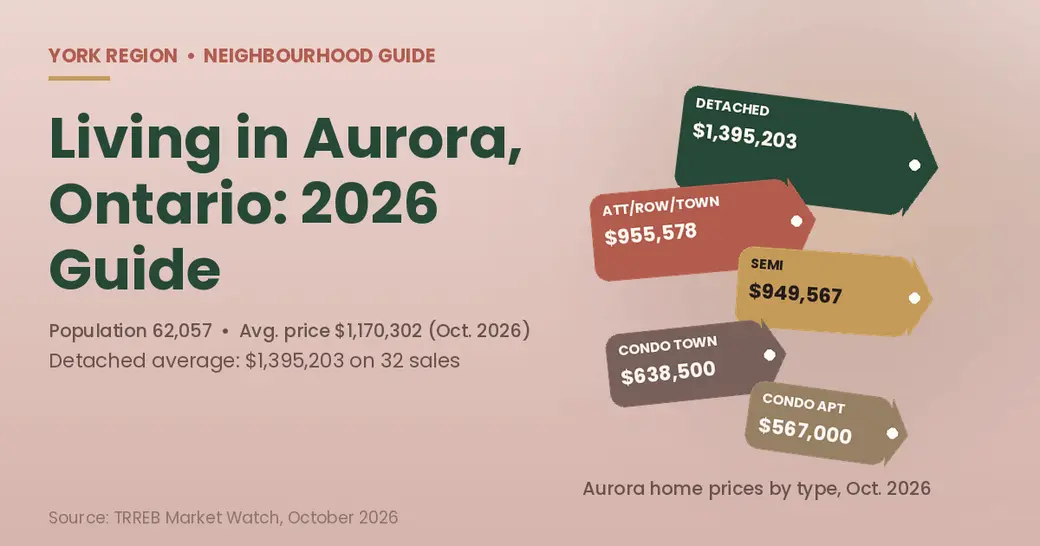
The Toronto Regional Real Estate Board's October 2026 Market Watch, in a release dated 4 November 2026, puts Aurora at 50 sales worth $58,515,088 in dollar volume, an average price of $1,170,302 and a median of $1,131,500. The dollar volume divided by the sale count matches the published average to the dollar, so the figure is a clean one.
Fifty sales in a month is a thin market, and the type-level breakdown shows how thin some segments really are.
| Property type (Aurora, Oct 2026) | Sales | Average price | Median price | New listings |
|---|---|---|---|---|
| Detached | 32 | $1,395,203 | $1,282,500 | 106 |
| Semi-detached | 3 | $949,567 | $980,000 | 7 |
| Att/row/townhouse | 5 | $955,578 | $900,000 | 19 |
| Condo townhouse | 8 | $638,500 | $638,000 | 15 |
| Condo apartment | 2 | $567,000 | $567,000 | 17 |
| All home types | 50 | $1,170,302 | $1,131,500 | 164 |
Source: TRREB Market Watch, October 2026.
Two sales is not a market, it's a handful of closings, so I'd treat the condo apartment row as directional only. The detached row, with 32 sales, is the one that actually drives the town-wide average — and at $1,395,203 it sits well above the GTA-wide detached figure, a reminder that Aurora's housing stock skews larger and more established than the GTA blend suggests.
For context, Aurora's average of $1,170,302 compares to $1,142,789 for York Region as a whole and $1,024,108 across the full TRREB market area in October 2026. Months of inventory in Aurora sat at 5.0, in line with York Region's 5.0 and a touch looser than the GTA-wide 4.6 — a modest edge for buyers willing to negotiate, though at 50 sales a month that edge can shift quickly.
Getting around: Aurora GO, Highway 404 and commuting from Aurora
Aurora GO Station sits on the Barrie line, with trains running to Union Station in roughly 45 minutes depending on the run. Metrolinx is partway through a multi-year upgrade at the station: a second platform and second track, rail signal upgrades, a rebuilt passenger pick-up and drop-off area, a new exit onto Berczy Street, an extended pedestrian tunnel with elevators, and 380 new overflow parking spaces at 9 Scanlon Court. Metrolinx has said the work is meant to enable future all-day, two-way, 15-minute GO service between Aurora and Union, but as of this writing it has not published a date for when that service actually starts — worth checking directly with Metrolinx before building a commute plan around it.
For drivers, Aurora sits directly on Highway 404, which makes the east side of town — including the Bayview Wellington area and the newer Aurora Mills Business Park near St. John's Sideroad and Leslie Street — an easy on-ramp to the 400-series network toward Toronto or north to Barrie. That business park, in development since zoning applications were first filed in 2015, now has an industrial condominium building and a self-storage facility under construction, plus a handful of quick-service restaurants opening along the frontage — a small but real sign of commercial growth on Aurora's east edge.
Schools in Aurora: what buyers with kids should check
Aurora is served by the York Region District School Board and the York Catholic District School Board, along with French-language boards. Boundaries in a growing town don't stay fixed, and Aurora is a case in point: YRDSB ran a public consultation on a proposed boundary change between Aurora Heights Public School and Devins Drive Public School, with a public meeting held 16 April 2025, and the revised boundary took effect for the September 2026 school year — meaning a child's assigned elementary school in parts of Aurora may have changed since last year even without the family moving.
I'd never guess at a school assignment for a specific street. Before writing an offer around a particular school, confirm the current boundary directly through YRDSB's School Boundary Information page or by calling the board's Planning Services department — it's a five-minute check that avoids a much more expensive surprise after closing.
Parks, trails and everyday life in Aurora
The Town maintains roughly 62 kilometres of trails, mostly compact gravel with some paved sections, built around four larger systems: the David Tomlinson Nature Reserve and Trail, the Willow Farm/Lakeview Trail System, the Tim Jones Trail and the Klaus Wehrenberg Trail.
The Tim Jones Trail — also known locally as part of the broader Nokiidaa Trail network — is Aurora's longest corridor, running from the Vandorf Woodlot in the south, through Sheppard's Bush Conservation Area, to the St. John's Boardwalk at McKenzie Marsh, with a branch continuing north into Newmarket and East Gwillimbury. The David Tomlinson Nature Reserve has boardwalks and viewing platforms over ponds and wetlands, plus a newer western trail section accessible from Tonner Crescent and Scrivener Drive. The Klaus Wehrenberg Trail runs through hardwood forest and connects into Sheppard's Bush as well.
On the civic side, the Town's 2026 capital plan includes a six-court pickleball complex at Fleury Park and the expansion of Lambert Willson Park's volleyball courts from two to four — small projects, but ones that tell you where recreation dollars are actually going this year, rather than where a glossy brochure says they might go someday.
Property taxes and the cost of living in Aurora
Aurora's council adopted its 2026 budget with a 2.2 per cent property tax increase — split between 0.6 per cent for Town operations, 0.6 per cent for Central York Fire Services, and 1 per cent directed to capital reserves. On a home assessed at $800,000, the Town estimates that works out to about $56.94 more per year, below the 2.9 per cent increase originally forecast in the Town's own multi-year plan. The operating budget runs $131.7 million, funded through property taxes and water, wastewater and stormwater user rates, alongside a ten-year capital plan worth $372 million, with $67.8 million allocated for 2026 projects such as local road rehabilitation, playground replacements and the Yonge Street streetscape redesign.
One thing that doesn't change the math: Aurora is not within the City of Toronto, so a buyer here pays only the provincial Ontario land transfer tax, not the additional municipal land transfer tax that applies inside Toronto's city limits. On a $1,131,500 median purchase, that's a meaningful difference worth running the numbers on — and a reason some buyers who'd otherwise look at a comparable Toronto property choose Aurora instead.
Is living in Aurora Ontario right for you?
Living in Aurora Ontario tends to suit a buyer who wants a GO train connection and a genuine small-town main street, but doesn't want to give up a detached lot to get it. If your budget centres on the $1.1 to $1.4 million range, Aurora's detached stock is the segment to focus on; if you're closer to $600,000 to $650,000, the condo townhouse and condo apartment segments exist but trade on very few monthly sales, so patience and flexibility on timing matter more here than in a deeper market like Mississauga or Brampton.
Sellers should know the reverse is also true: with only 50 sales town-wide in October 2026, a listing that's priced even slightly off the market can sit, and the 39-day average time on market in Aurora already runs longer than York Region's 33-day average. Pricing accurately from the first day matters more in a thin market than in a busy one.
Frequently Asked Questions About Living in Aurora Ontario
Q: Is Aurora Ontario a good place to live in 2026? For buyers wanting a detached home, a GO train connection and a walkable downtown, yes — Aurora's population grew almost 12 per cent between the 2016 and 2021 Census, and the Town continues investing in trails, parks and its Yonge Street corridor.
Q: What is the average home price in Aurora, Ontario? Aurora's average sale price was $1,170,302 across 50 sales in October 2026, with a median of $1,131,500, according to the Toronto Regional Real Estate Board. Detached homes averaged $1,395,203 on 32 sales that same month.
Q: How do I get from Aurora to downtown Toronto? Aurora GO Station, on the Barrie line, puts Union Station about 45 minutes away by train, with Highway 404 running along the town's east side for drivers. Metrolinx is currently upgrading the station with a second platform, a new pedestrian tunnel and additional parking.
Q: What school boards serve Aurora, Ontario? Aurora is served by the York Region District School Board and the York Catholic District School Board, plus French-language boards. Boundaries can change — a 2025 review moved the line between Aurora Heights Public School and Devins Drive Public School effective September 2026.
Q: Does Aurora have its own municipal land transfer tax? No. Aurora is outside the City of Toronto, so buyers pay only the provincial Ontario land transfer tax, not the additional municipal tax that applies to purchases within Toronto's city limits.
Ready to explore Aurora?
Three things to carry away about living in Aurora Ontario. It's a thin but resilient market — 50 sales in October 2026 at an average of $1,170,302, above both the York Region and GTA-wide averages, with the detached segment doing most of the heavy lifting. It's genuinely growing, up almost 12 per cent in population between the two most recent Census counts, with real infrastructure dollars following that growth at the Aurora GO Station and across 62 kilometres of Town trails. And school boundaries here move, so a specific address needs a specific check before you count on a specific school.
If you're weighing Aurora against Newmarket, Richmond Hill or anywhere else in York Region, I'd rather walk you through the numbers for your actual price range than have you work off a headline average. Schedule a free consultation or call me at (905) 872-2682.
Navneet Bhasin, eXp Realty, Brokerage — serving Brampton, Mississauga, Toronto and the Greater Toronto Area. Over 150 five-star Google reviews. teamnav.ca | (905) 872-2682
This article is general information, not financial, mortgage, legal or tax advice. Market data is from the Toronto Regional Real Estate Board's October 2026 Market Watch, released 4 November 2026, and conditions change. Confirm school assignments with the York Region District School Board or York Catholic District School Board, budget and tax figures with the Town of Aurora, and mortgage terms with a licensed mortgage professional.
Categories
Recent Posts