Moving to Newmarket from Toronto: 2026 Guide
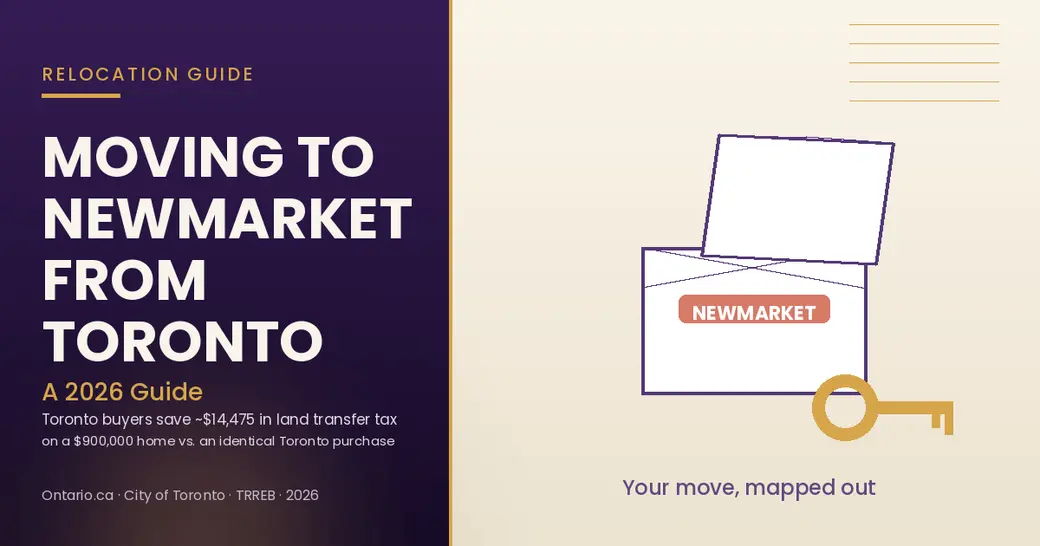
Moving to Newmarket from Toronto usually comes down to the same trade: a longer commute in exchange for more house, a quieter street, and a land transfer tax bill that's roughly half what you'd pay inside the city. Newmarket is a historic market town of about 84,000 people in York Region, built around a walkable 19th-century Main Street, a GO station on the Barrie Line, and a housing stock that still includes detached homes a Toronto buyer's budget can actually reach. It isn't a suburb in the generic sense — it's its own municipality with its own council, its own growth plan, and a downtown older than most of the GTA. As a GTA real estate agent who works across the region, I help clients make this exact move every month, and the questions are almost always the same: what will I actually save, which neighbourhood fits my life, and how bad is the commute, really.
Key Takeaways
- Newmarket's population was 84,224 at the time of the most recent federal census, with the Town's own economic profile putting the current estimate closer to 90,000 (Town of Newmarket Economic Development, 2026).
- A Newmarket buyer pays only Ontario's provincial land transfer tax — Toronto layers on an identical municipal tax, roughly doubling the bill (City of Toronto and Ontario.ca, 2026).
- York Region's October 2026 average resale price was $1,142,789 against the City of Toronto's $1,075,627, so Newmarket itself (a smaller, mostly-freehold market within that region) is not automatically cheaper on paper — the savings show up in taxes, space per dollar, and parking, not necessarily sticker price (TRREB Market Watch, October 2026).
- Newmarket GO on the Barrie Line gets you to Union Station without a car, with free parking at the station — a real option for a Toronto commuter who wants to keep working downtown.
- Council approved the Shining Hill Secondary Plan in February 2026, opening roughly 1,000 to 1,500 new homes in southwest Newmarket — one of the largest new-supply additions the town has approved in years (Town of Newmarket, 2026).
Quick Answer: Is Moving to Newmarket from Toronto Worth It?
For a buyer who needs more space than a Toronto budget delivers, Newmarket trades a GO-train commute for a historic downtown, a lower overall tax bill at closing, and a real chance at a detached home with a driveway. It won't suit someone who needs to be car-free and walkable to a downtown office every day without exception, and it isn't automatically "cheaper" per square foot than every part of Toronto — the math depends on the neighbourhood and property type on both ends of the move.
Why People Are Moving to Newmarket from Toronto in 2026
The pattern I see in my own client base is consistent: a couple or young family who has been priced out of the Toronto neighbourhood they'd ideally stay in, and who wants a freehold home with a yard rather than another condo renewal. Newmarket offers that without leaving the GTA or giving up a GO-train commute back into the city.
It also offers a real downtown. Main Street Newmarket is a protected heritage district — restored 19th-century storefronts, independent shops, restaurants, and a public square (Riverwalk Commons) that hosts markets and events through the year. That's a different proposition from a 905 bedroom community with no centre of its own, and it's one of the things that shows up most often in client feedback after the move.
Then there's the tax math, covered in detail below: Toronto's municipal land transfer tax doesn't exist in Newmarket, because Newmarket isn't the City of Toronto. On a typical purchase, that alone is worth tens of thousands of dollars at closing.
Newmarket vs Toronto: Home Prices and Land Transfer Tax Savings
TRREB's October 2026 Market Watch (released November 4, 2026) reports results at the York Region level rather than breaking Newmarket out on its own in every table, so the regional figures below are the closest verified comparison available this month — ask me for Newmarket-specific comparables when you're ready to look at real listings.
| Market (October 2026) | Sales | Avg. Price | Median Price | Active Listings | Avg. SP/LP |
|---|---|---|---|---|---|
| York Region (incl. Newmarket) | 1,038 | $1,142,789 | $1,050,000 | 4,932 | 97% |
| City of Toronto | 2,184 | $1,075,627 | $835,000 | 9,526 | 98% |
Source: Toronto Regional Real Estate Board (TRREB), Market Watch, October 2026.
York Region's average is pulled upward by detached homes in its lower-density municipalities; Newmarket's own mix of freehold streets and condo buildings around Yonge and Davis sits inside that regional number without a published figure of its own this month. The practical takeaway for a Toronto buyer: don't assume York Region is automatically cheaper on a price-per-home basis — it's the land transfer tax and the amount of house you get for that price that usually make the real difference, not the headline average.
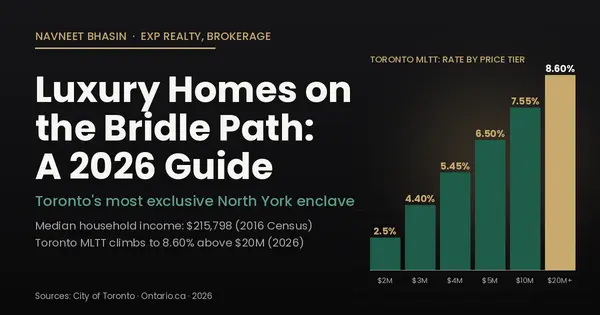
That tax difference is concrete and fully sourced. Ontario's provincial land transfer tax applies everywhere in the province on a graduated scale: 0.5% up to $55,000, 1.0% from $55,000 to $250,000, 1.5% from $250,000 to $400,000, 2.0% from $400,000 to $2,000,000, and 2.5% above that (Ontario.ca, 2026). The City of Toronto charges an additional municipal land transfer tax on top of the provincial one, using the same bracket structure up to $2,000,000 and then its own graduated top rates above $3,000,000, running as high as 8.60% on the portion of a sale price over $20,000,000 (City of Toronto, rates effective April 1, 2026).
| Provincial LTT | Toronto Municipal LTT | Total Payable | |
|---|---|---|---|
| $900,000 home in Newmarket | $14,475 | Not applicable | $14,475 |
| $900,000 home in Toronto | $14,475 | $14,475 | $28,950 |
Figures calculated from Ontario's published 2026 provincial land transfer tax brackets and the City of Toronto's published 2026 municipal land transfer tax brackets, which mirror the provincial structure below $2,000,000.
On a $900,000 purchase, that's roughly $14,500 that stays in a Newmarket buyer's pocket at closing — enough for a down payment top-up, moving costs, or a real furniture budget. I am a real estate agent, not a mortgage professional or tax advisor, so treat this as general information about public tax brackets rather than advice about your own closing costs.
Newmarket Neighbourhoods to Know Before You Move
Newmarket is compact — you can drive across it in about 15 minutes — but its neighbourhoods have distinct characters worth knowing before you start touring.
Historic Downtown, centred on Main Street and Fairy Lake, is the closest thing Newmarket has to a Toronto-style walkable core: heritage buildings, independent retail, and a short walk to the GO station. It suits a buyer who wants to give up the car for daily errands even after leaving Toronto.
Stonehaven, in north Newmarket, is a newer, family-oriented subdivision of detached and semi-detached homes built mostly from the late 1990s onward, close to Upper Canada Mall and Highway 404.
Glenway, built around the Glenway Golf Course in the town's south end, is one of Newmarket's more established and leafy pockets, popular with move-up buyers who want mature trees and larger lots.
Woodland Hill, in southwest Newmarket, is a planned community with its own parks (including Woodland Hill Labyrinth Park) and newer construction, appealing to buyers who want a modern build without leaving the town's borders.
Summerhill Estates, also in the south end near the Aurora boundary, is a quieter, established residential pocket with a mix of housing types and easy Highway 404 access.
Watch for Shining Hill in southwest Newmarket, too — council approved its secondary plan in February 2026, opening an 83-hectare area west of Yonge Street for roughly 1,000 to 1,500 new homes, described by the Town as aiming for "intrinsic affordability" alongside energy-efficient design. It's a community that doesn't fully exist yet, but it's one of the clearest new-supply stories in the GTA north of Toronto right now.
The Newmarket GO Commute Back to Toronto
If keeping a downtown Toronto job is the condition on this move, the Newmarket GO Station is the piece that makes it workable. It sits on the Barrie Line with direct service toward Union Station, free customer parking (the main lot alone holds 271 spaces), bike racks, and connections to York Region Transit (GO Transit, 2026). Metrolinx's broader GO Expansion program is working toward more frequent, all-day, two-way service across the network over roughly the next decade, though no Newmarket-specific timeline has been published for that build-out, so I won't invent one.
By car, Newmarket sits directly on Highway 404, which connects south to the Don Valley Parkway and the rest of the Toronto highway network — useful for anyone commuting to a job outside the downtown core, where GO rail doesn't reach as directly.
Schools in Newmarket: YRDSB and YCDSB
Newmarket is served by both the York Region District School Board (public) and the York Catholic District School Board (Catholic), the same two boards that cover the rest of York Region. Newmarket High School and Huron Heights Secondary School are the town's two public secondary schools, alongside a full set of elementary schools spread across its neighbourhoods.
School boundaries shift from year to year as enrolment and new construction change, so I always point relocating families to the boards' own tools rather than a static map: YRDSB's school locator, and YCDSB's school list for its Newmarket-area schools. If a specific school's boundary matters to your decision, confirm it directly with the board before you write an offer — not from a blog post, mine included.
What's Coming: Newmarket's Growth Plans Through 2026 and Beyond
Newmarket's Urban Centres Secondary Plan, centred on the Yonge Street and Davis Drive intersection, covers about 290 hectares and is planned to eventually support roughly 33,000 residents and 32,000 jobs through intensification rather than outward sprawl — the Town's Provincial Urban Growth Centre designation for the area. The Davis Drive Viva rapidway through that corridor is already complete, with work underway on the Yonge Street rapidway as well.
Separately, Upper Canada Mall's owner has worked with the Town on a long-range plan for the mall lands that envisions more than 5,000 new residential units, mostly rental, over a 30-to-40-year build-out, with an affordable housing target in the 25-to-35% range. That kind of timeline means it won't change your house hunt this year, but it signals where the town's centre of gravity is headed over the next generation.
Across York Region as a whole, population has grown to roughly 1.28 million as of 2024 and is forecast to pass 2 million by 2051 — Newmarket's own share of that growth is baked into plans like Shining Hill and the Urban Centres Secondary Plan rather than left to chance.
Parks, Trails and Everyday Life in Newmarket
Fairy Lake Park, at 13.4 hectares of parkland, waterway and marsh around the town's namesake lake, is the heart of Newmarket's outdoor life — an amphitheatre, picnic areas, a playground, and the Tom Taylor Trail looping the lake and connecting into Riverwalk Commons right downtown. It's the kind of amenity a lot of Toronto neighbourhoods simply don't have room for, and it's a five-minute walk from Main Street's restaurants and shops.
For a buyer leaving a Toronto condo or semi, that combination — a real downtown, a lake and trail system, and a GO line back to the city — is usually the thing that closes the deal, more than any single price comparison.
Frequently Asked Questions About Moving to Newmarket from Toronto
Is Newmarket part of Toronto or a separate city?
Newmarket is its own town, located in York Region, roughly 30 to 40 minutes north of downtown Toronto depending on traffic and route. It has its own municipal council, official plan, and tax rates — it is not a Toronto neighbourhood or borough.
How much does moving to Newmarket from Toronto actually save on closing costs?
The clearest, fully verified saving is land transfer tax: Toronto charges its own municipal land transfer tax on top of Ontario's provincial tax, using an identical bracket structure up to $2,000,000, which roughly doubles the tax bill compared with a purchase in Newmarket. On a $900,000 home, that's about $14,475 that a Newmarket buyer doesn't pay.
Can I commute to downtown Toronto from Newmarket without a car?
Yes. Newmarket GO Station is on the Barrie Line with direct train service toward Union Station, free parking, and connecting York Region Transit buses, making a car-free commute realistic for someone working in or near Toronto's downtown core.
What's the best Newmarket neighbourhood for a family leaving Toronto?
It depends on what you're optimizing for. Families who want a walkable centre often choose the Historic Downtown area near Main Street; those who want newer construction and more square footage often look at Stonehaven, Woodland Hill, or the upcoming Shining Hill community in the southwest end.
Will Newmarket home prices stay lower than Toronto's?
Not necessarily at the headline average — York Region's October 2026 average price actually ran slightly above the City of Toronto's citywide figure, largely because Toronto's average blends in a large volume of lower-priced condo apartments. The real, consistent difference is in land transfer tax and, often, the amount of detached house you can get for a comparable budget.
Ready to Make the Move to Newmarket?
Moving to Newmarket from Toronto is one of the more straightforward relocations in the GTA — close enough for a GO commute, different enough to feel like a real change, and backed by a town that's actively planning for its next decade of growth. Whether you're drawn to the Historic Downtown, a family street in Stonehaven or Glenway, or you want to get in early on a community like Shining Hill, the right fit depends on your budget, your commute tolerance, and what "more space" actually means to you.
I'm Navneet Bhasin, a real estate agent with eXp Realty, Brokerage, and I help Toronto buyers make exactly this kind of move across the GTA every month. Thinking about moving to Newmarket from Toronto? Schedule a free consultation with me, call (905) 872-2682, or email nav@teamnav.ca, and let's find the neighbourhood that actually fits your life.
This post is for general information only and is not financial, mortgage, legal or tax advice. Land transfer tax figures are calculated from published 2026 provincial and municipal rate schedules; confirm current rates and your own closing costs with a lawyer or the relevant government office before relying on them.
Categories
Recent Posts